As NJ Reels from Rising Electricity Costs, New Battery Funding Offers a Way Forward
May 15, 2026
|
Clay Meyer
Summary
Rate shock is here to stay: New Jersey commercial and industrial electricity costs rose by double digits between 2024 and 2025 – including a 16% single-year increase at PSE&G – and high PJM capacity prices are locked in through at least 2029.
Batteries let you fight back: Battery systems with optimized dispatch reduce the capacity and demand charges driving these increases by discharging during the specific hours that set them – without impacting facility operations.
New funding is coming: New Jersey's Garden State Energy Storage Program (GSESP) will add new incentives for on-site batteries. Scale's recent webinar covers how to qualify, and why application-ready projects will win limited funding.
Last summer, we sounded the alarm: a seismic event for electricity costs was underway in New Jersey and the broader mid-Atlantic region, and businesses were going to feel it in a significant way. That rate shock has now fully materialized on utility bills statewide, including a 16% single-year rate increase in PSE&G, the state’s largest utility. This isn't just a blip either, instead reflecting a structural shift in the regional electricity market that isn’t going to shift back anytime soon.
In a recent webinar, experts from Scale walked through the challenges facing our New Jersey customers, the unique power of battery storage solutions to address them, and the incentives the state is rolling out that can make these systems even more valuable. Fill out the form below if you want to view the webinar, which includes insights from our regulatory expert on how to qualify for these incentives, or read on for the high-level story.
Why are NJ rates going up? (and up, and up)
After fifteen years of increasing at a pace of about 1% per year, average electricity rates across New Jersey have been increasing by 6% on average since 2020, driven by a steady increase in investments in aging utility grids and elevated natural gas price. The even sharper acceleration over the past year comes from capacity charges, which have spiked as regional grid supply has tigthened.
Electricity bills include multiple components – supply charges, demand charges, and capacity charges – and all three have been moving in the wrong direction. But capacity is the headline. Capacity charges are calculated based on your facility's electricity usage during a small number of critical peak hours each year. Think of it as a bill for the amount of supply on the transmission grid that has to be kept available for you during the moments of highest system-wide stress.
When grid capacity gets tight, those charges spike. And thanks to rapidly increasing demand (due in part, but not entirely, to data center growth) and retirements of aging fossil fuel plants, it has suddenly gotten very tight. The regional PJM capacity market, which covers New Jersey and much of the mid-Atlantic, saw average auction prices jump from an average of roughly $90 per megawatt-day (MW-day) over the prior 15 years to hit the auction cap of over $300 for each of the past four years – and, without the cap, PJM simulated that prices would have hit $555 per MW-day (updated September 2026).
Those prices began hitting bills last year and are now locked in through at least 2029. With demand still surging from data centers and new industrial loads, and new supply stuck in years-long interconnection queues, elevated prices are expected to persist for the foreseeable future.
These higher prices would be (slightly) easier to swallow if the grid was becoming more reliable – but that’s a tall order given the challenges utilities are facing. New Jersey businesses face ongoing risks of outages caused by increasingly-frequent extreme weather events like nor’easters and tropical storms. In 2018 and again in 2020, major weather events knocked out power for more than a million utility customers for hours or even days at a time, and the next major storm is always just around the corner. Businesses also have to contend with “blue sky” failures of the aging distribution network can result in multiple outages per year in some areas.
For the growing number of businesses in industries like manufacturing and food processing that rely on increasing levels of automation, even losing power for a few seconds can cause tens or hundreds of thousands of dollars of direct and indirect costs.
The combined effect: businesses are paying significantly more for power with no guarantee of greater reliability, undercutting their bottom line and hurting their competitiveness.
How do batteries cut electricity costs?
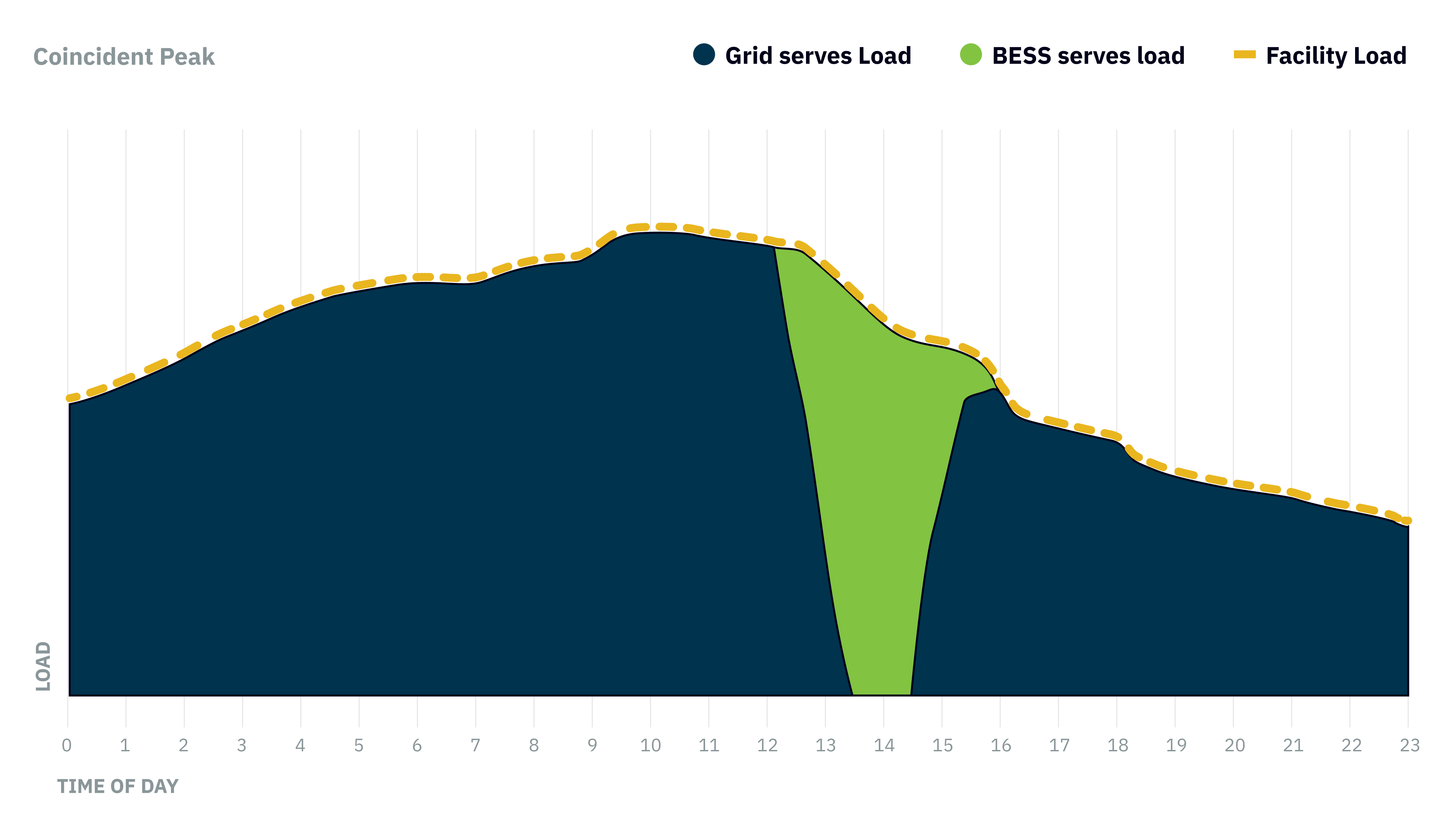
Battery storage reduces electricity costs by discharging during the specific hours that set capacity and demand charges, lowering a facility's measured peak load without any change to operations. For large New Jersey facilities, capacity charges alone can add hundreds of thousands of dollars per year – and they're set during a handful of hours that can be forecast in advance.
Those critical hours can be predicted using algorithms that analyze historic demand patterns, weather, and real-time grid conditions. Batteries, dispatched intelligently against those forecasts, dramatically reduce your measured load during exactly those windows. The battery meets your needs so the grid doesn't have to, and your “capacity tag” comes down accordingly.
The same logic applies to demand charges, which are set by your own peak usage hour each month rather than the grid's. The hours to target are different, and the charges support investments in your local distribution grid infrastructure, not regional PJM-level transmission system – but batteries smooth those peaks the same way. An experienced microgrid operator can ensure that these savings are optimized alongside annual capacity charge savings.
Batteries also enable advanced microgrids to provide enhanced reliability performance. Solid-state electronics can detect a failure on the grid and activate full backup power support in milliseconds, versus traditional backup generators that typically take 30 seconds or more to start and ramp up. When properly integrated with microgrid controls, batteries can ensure sensitive operations never skip a beat when an outage hits. For automation-heavy facilities, this capability can be worth even more than the utility bill savings.
In our webinar, we walked through the math on how this value stacks up, including a real-world case study from a large commercial facility that illustrates the benefits on both the cost savings and reliability side. Request the recording to dig in.
What is the Garden State Energy Storage Program (GSESP)?
The Garden State Energy Storage Program (GSESP) is New Jersey's statewide incentive program for battery storage, created by the Board of Public Utilities (BPU) to meet the state's mandate of 2,000 MW of energy storage by 2030. Phase 2 of the program – the segment covering distributed, behind-the-meter systems like commercial and industrial batteries – will pair up-front installation incentives with ongoing performance payments for supporting the grid during hours of peak demand.
When we first flagged this program last summer, it was still a work in progress. It's now taking shape: the BPU launched Phase 1 for large transmission-connected, utility-scale projects in 2025, and in August 2026 it released its first straw proposal for Phase 2, which will be open to commercial and industrial facility-scale projects (updated September 2026). Based on what has been proposed thus far, we expect the finalized program to be lucrative enough to make the economics of battery microgrids even stronger.
The details are covered in the webinar, but this much is clear: the funding is limited, and it will be allocated on a first-come, first-served basis. Projects that are ready to apply when blocks of incentive capacity become available will thus have a meaningful advantage over those that are still in early planning stages.
Why does acting now matter?
Energy costs in New Jersey are not heading back to where they were. The rate environment that produced a 16% single-year PSE&G rate increase is the same one that will shape bills in 2026, 2027, and beyond. For companies looking to get ahead of these mounting costs, time is of the essence – especially if they want to tap into the new GSESP incentives.
Scale's business is built to make this value proposition as accessible as possible for our customers. We design, build, own, and operate these systems under a Microgrid Service Agreement (MSA) that requires $0 down, with a fixed monthly fee that's structured to deliver cost savings from day one. We handle the complexity – the engineering, the incentive applications, the ongoing optimization – so your team doesn't have to.
To learn more, watch the full webinar by filling out the form below, which covers the program details, eligibility requirements, and case study, or reach out directly to talk through your facility's situation. Whether you're just starting to think about what battery storage could mean for your facility, or you're already tracking the GSESP and want to understand how to position your project, we'd welcome the conversation.
Frequently Asked Questions
What is a capacity charge?
A capacity charge is the portion of an electricity bill that pays for the generation supply that must be kept available to serve your facility during the grid's highest-stress hours. It is calculated from a commercial or industrial facility’s electricity demand during just a handful of critical peak hours each year, which can be predicted in advance. In the PJM region, capacity charges have soared, driving significant utility bill increases in states like New Jersey and Illinois.
How much did New Jersey electricity rates increase in 2025?
Commercial and industrial electricity costs rose by double digits in many New Jersey utility territories between 2024 and 2025, including a 16% single-year rate increase at PSE&G, the state's largest utility. Looking back over the past two decades, statewide average rates have grown about 6% per year since 2020 compared with just 1% per year from 2005 to 2020.
Can batteries replace backup generators during outages?
Yes and no. Batteries integrated with microgrid controls can detect a grid failure and switch to backup power in milliseconds, compared with 30 seconds or more for traditional standby generators. For automation-heavy operations where even a momentary power loss is costly, this capability can be extremely valuable. However, because batteries may only have enough capacity to provide a few hours of backup, many microgrids pair them with on-site fuel-based backup generators to provide extended-outage coverage while minimizing overall costs and emissions.
When can NJ businesses apply for GSESP battery incentives?
Nowhere yet – the BPU is finalizing the design of GSESP Phase 2, the segment covering distributed and behind-the-meter storage, and released its first straw proposal in August 2026. Application windows haven't opened yet, and the incentive is expected to be awarded in first-come, first-served capacity blocks, so getting a project application-ready before the program launches will provide an advantage in securing funds.