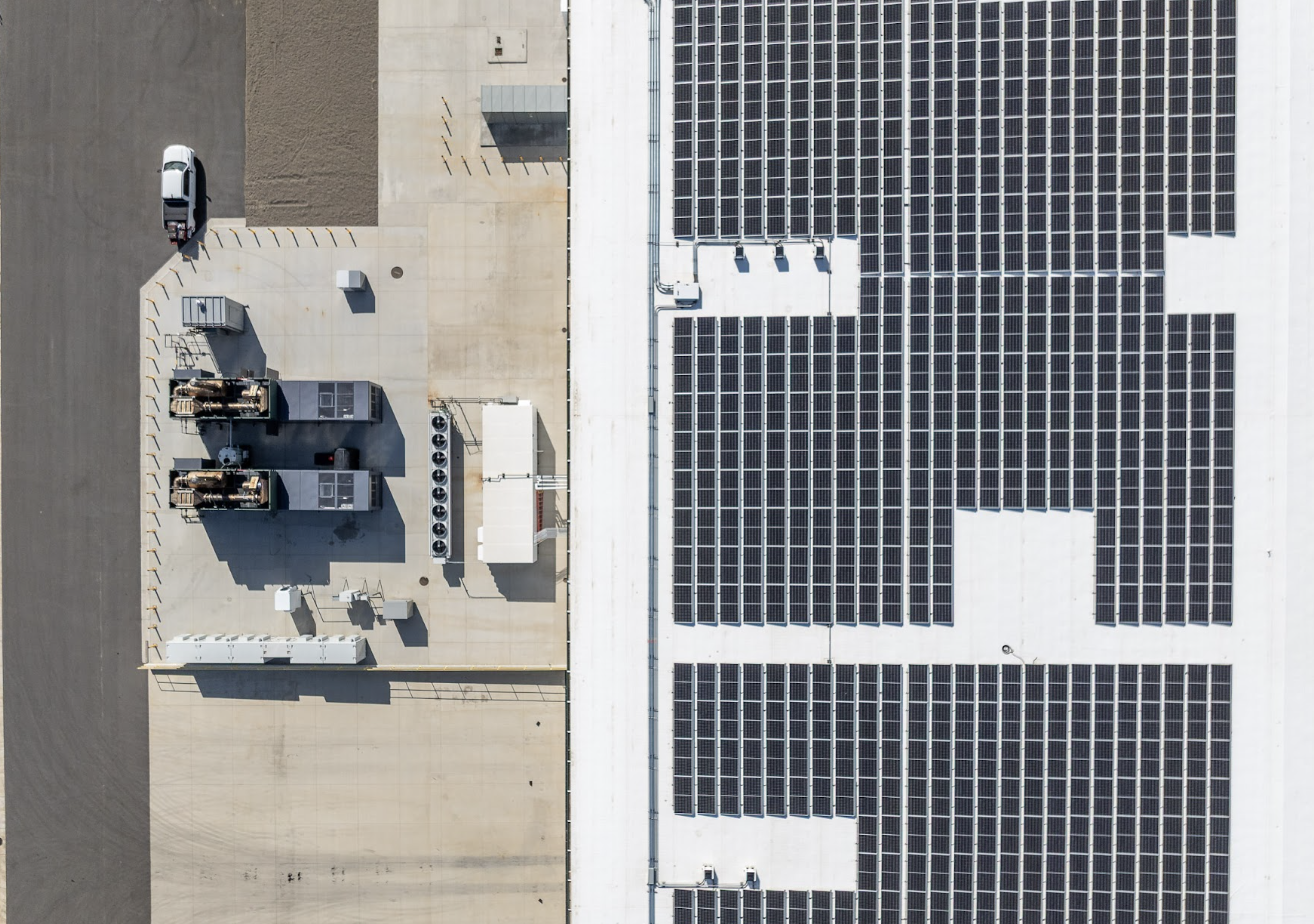
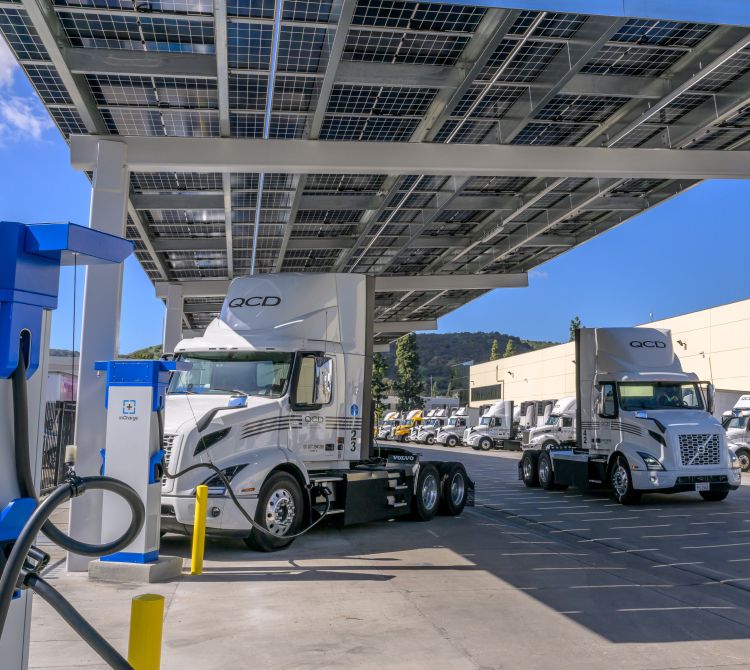
What enhanced reliability means: Enhanced reliability solutions feature closed transitions to backup power that keep sensitive operations powered through grid failures, along with layers of multiple on-site energy assets with co-optimized dispatch to power through extended outages while minimizing fuel use.
How we make enhanced reliability affordable: Scale's advanced microgrids combine battery storage, solar, and generators with sophisticated controls designed and configured with in-house expertise, enabling us to offer backup power that responds in milliseconds as a standardized product rather than a custom engineering project.
Why reliability value is worth quantifying: Surveys by ABB and Siemens put unexpected downtime costs above $100,000 per hour for many types of large commercial and industrial facilities, and some Scale customers have estimated that routine outages can cost a single facility over $1 million a year.
Power quality problems? Get a free microgrid evaluation.
Scale’s advanced microgrids offer enhanced reliability solutions for large commercial and industrial facilities, going beyond traditional backup generators in two important ways: they can respond to a grid failure in milliseconds, and they can sustain a facility through outages lasting days while minimizing fuel costs and emissions. And because we have standardized the design and delivery of these systems, we can offer capabilities that would typically require expensive, time-consuming custom engineering as an affordable, repeatable product.
That combination matters more every year for many businesses. Between hurricanes, wildfires, nor’easters, derechos, and an aging grid, almost every region of the country has experienced a year with 8 or more hours of outages in recent memory, with the national average of annual outage hours hitting the highest level in over a decade. And as automation spreads across more and more industries, even brief outages or power quality issues can result in disruptions costing hundreds of thousands of dollars.
With an extensive track record of providing ultra-high uptime power solutions for both grid-connected and off-grid systems, Scale’s industry-leading engineering team has earned the trust of customers ranging from college campuses to cold storage facilities to data centers. So, if the grid is endangering your bottom line, Scale can flip that equation on its head with advanced microgrids that turn reliability challenges into competitive advantages.
How Much Do Power Outages Cost Businesses?
Recent surveys by ABB and Siemens found unexpected downtime costs of over $100,000 per hour for many types of industrial facilities, and some Scale customers estimate that routine power outages can cost a single facility more than $1 million per year. As core processes in manufacturing, logistics, food processing, and other industries become automated, even outages lasting just a few seconds – before a diesel backup generator can ramp up – can result in cascading disruptions to operations that last hours, potentially adding up to hundreds of thousands of dollars per incident.
Where do those costs come from? Direct costs are the obvious ones:
Lost revenues: Production delays, missed transactions, and other costs hit the top line immediately.
Lost product: Spoilage or other product damage can wipe out entire batches or inventory.
Idled labor: Wages are still paid to employees who are unable to work during the outage and recovery.
Recovery costs: Repairs, overtime and contractor pay, and replacement equipment add more costs post-outage.
Indirect costs, on the other hand, are incurred downstream of the outage and may be harder to quantify – but they can be just as large, if not larger. These include:
Supply chain disruptions: Ripple effects cascade to partners and customers who were counting on your output.
Expediting fees: Making up for lost time and shipments adds a cost premium.
Contract penalties: Missed Service Level Agreements or compliance standards carry direct financial costs.
Reputational damage: While difficult to measure, erosion of customer trust can last for years after the event.
How all these costs add up varies by industry and by outage duration. For automated warehouses, an hourlong power outage can lead to cascading delays, SLA penalties, and angry customers. For food processors, the loss of temperature control and pressurization in clean rooms for a few minutes can require entire batches to be thrown out. And for the precise manufacturing processes used to produce goods like injection-molded plastics or chemicals, the loss of power for just seconds in the middle of a production run can mean not only losing product but losing hours of time to clean out and recalibrate sensitive equipment.
To put a real number on your own facility, the U.S. Department of Energy’s Customer Damage Function Calculator, created by the National Laboratory of the Rockies, offers a methodical process for generating facility-specific estimates, with inputs including fixed costs, spoilage costs, and how incremental costs accrue over time.
How Do You Choose the Right Reliability Solution?
Determining the best-fit reliability solution for a customer comes down to two factors: how sensitive your operations are to power interruptions, and how long your outage protection needs to last.
1.How sensitive are your operations to power outages? For example:
Do brief interruptions to certain processes result in wasted materials or degraded services?
Are there critical environmental management systems which need to run continuously?
Do all IT or controller-based systems already have their own batteries or UPS systems, or are they vulnerable to disruption from power quality issues?
2. How long should your outage protection last? For example:
Do you have systems that must run hourly or daily to avoid spoilage or other financial losses (e.g. cold storage)?
What is the financial impact of an unexpected multi-hour facility shutdown? What about a multi-day shutdown?
Do you currently have backup generators on-site? How much of your load do they cover?
If you have diesel generators, how much fuel is stored on-site and how often is it replaced?
Locational factors can shape both of these factors. On sensitivity, it matters whether your local distribution grid suffers from power quality issues, which can disrupt operations even without causing an outright outage. And on duration, some areas face far higher risks of extended outages – most notably California, where wildfires, as well as public safety power shutoff (PSPS) events to prevent wildfires, have resulted in multi-day regional outages in recent years.
How Fast Can a Microgrid Switch to Backup Power?
If a facility’s operations are sensitive to short power outages, Scale’s advanced microgrids with integrated battery storage can transition to backup power in milliseconds, fast enough that the facility never fully loses power when the grid fails.
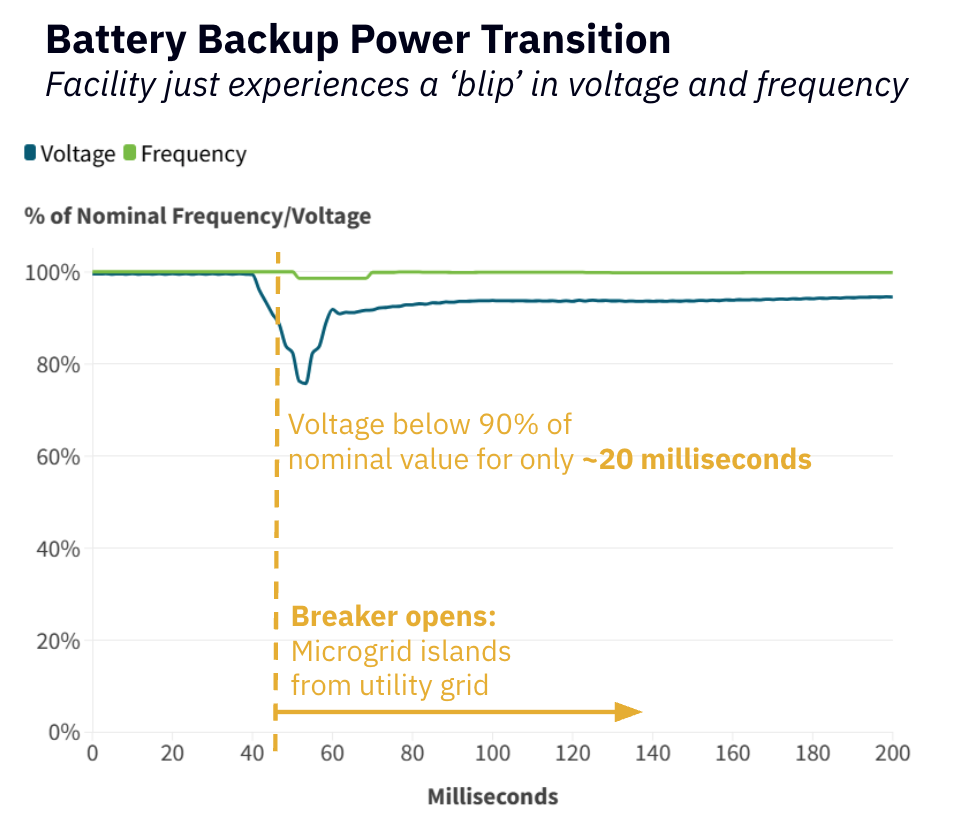
To understand how that speed is possible, let’s zoom in on what happens to a facility’s operations when a fault occurs on the utility grid. The voltage and/or frequency of the facility’s power supply begin to drop, tripping the main breaker and isolating (or “islanding”) the facility from the grid – at which point frequency and voltage fall precipitously. All of this occurs within the blink of an eye, about 100 milliseconds or less.
What happens next depends on what type of backup power the facility has.
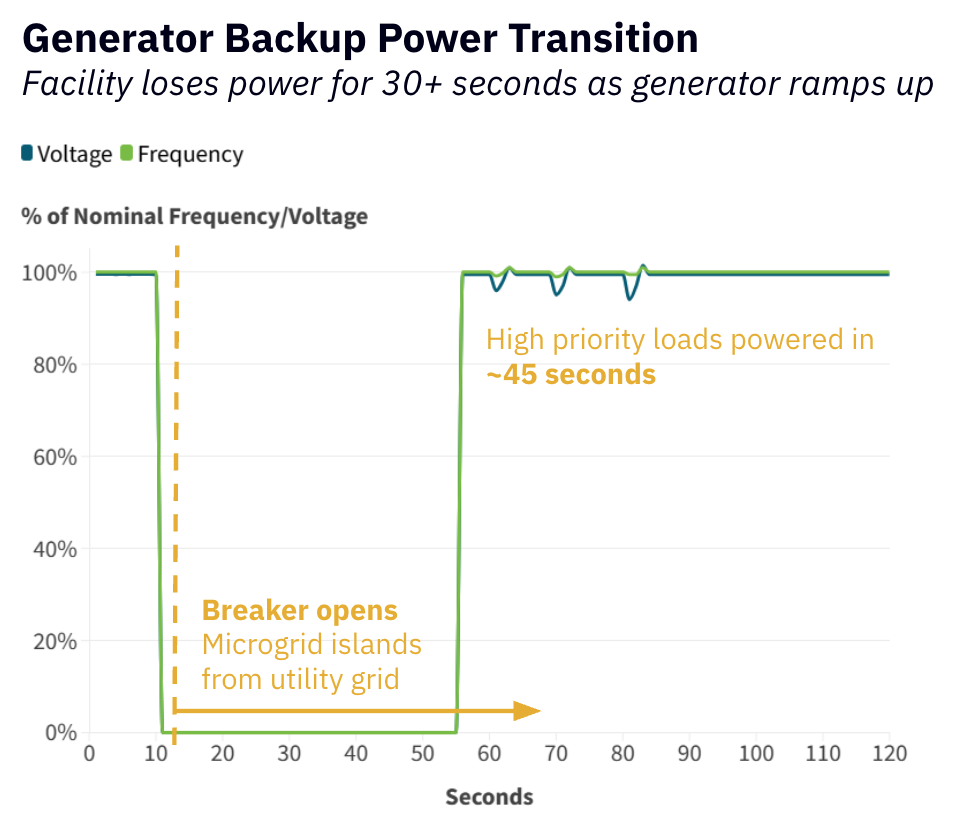
An “open” transition means the facility completely loses power while backup generation starts. A natural gas generator, even an automated one with basic microgrid controls, typically takes 30 seconds or more to start, ramp up, close the breaker, and begin powering the facility. An older diesel generator requiring manual startup can add several more minutes in the dark – potentially enough to disrupt manufacturing processes, force equipment restarts, and cost real money.
In a “closed” transition, the facility never fully loses power. Battery systems don't rely on a mechanical ramp-up; their solid-state power electronics detect the grid failure and pick up the full load in milliseconds, so the facility experiences only a brief blip in voltage and frequency. Scale’s controls expertise harnesses that speed to deliver a transition faster than any fossil fuel generator can manage.
Closed transitions are fast enough to prevent disruptions in food production facilities, manufacturing plants, and other operations that rely on mechanical processes. For power quality-sensitive electronics like industrial control systems, we can incorporate device-specific UPS systems to ensure total ride-through.
Other companies can provide this level of “closed” transition capabilities, but only through costly, time-intensive custom engineering and static transfer switches. At Scale, our engineering and design expertise lets us deliver it faster and more affordably as a standard feature for our advanced microgrids.
How Long Can a Microgrid Provide Backup Power?
Scale’s advanced microgrids that include fuel-based generation alongside solar and storage can provide low-emission, unlimited-duration backup power – another key to providing truly enhanced reliability capabilities. Solar-plus-storage and storage-only configurations can deliver extended, zero-emission multi-hour protection, particularly when non-essential loads can be shed.
As with traditional backup solutions, powering through a multi-day outage with an advanced microgrid requires a source of fuel-based generation, whether one of our low-emission natural gas generators or an existing diesel generator (including diesel generators). What makes Scale's solution different is how this generation works alongside other assets: our controls programming expertise allows us to co-optimize the dispatch of solar and battery storage along with the generator to reduce fuel costs and lower emissions.
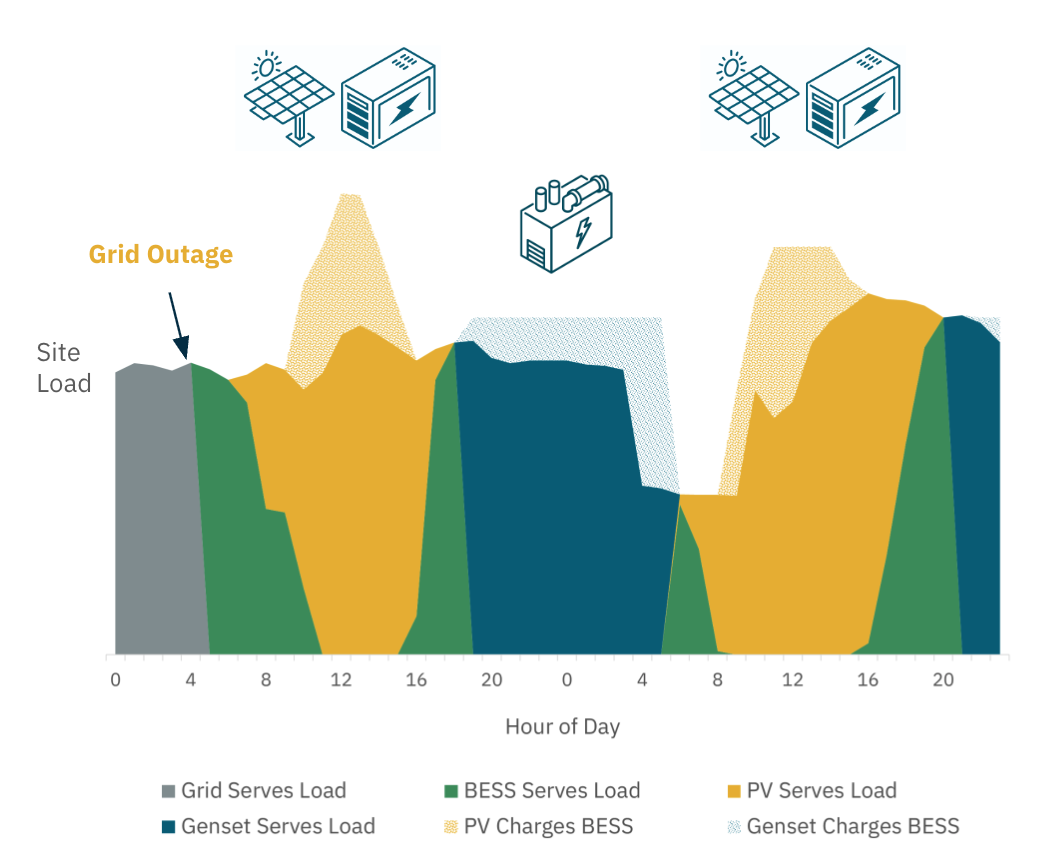
For example, if an outage hits in the early morning, the microgrid would dispatch the battery first, then rely on solar to power the facility and recharge the battery during the daytime; in the evening, power would be provided by the remaining battery capacity before switching over to the generator to recharge the battery and power through the night and early morning, when the cycle repeats. By switching between resources as necessary, we can provide unlimited duration backup while minimizing generator runtime and maximizing its efficiency.
If you don’t need to plan around multi-day outages or don’t want to install a fuel-based generator as part of your system, our intelligent dispatch and design can also deliver extended, multi-hour backup from solar and storage or even storage-only systems, particularly if you have non-essential loads that we can shed.
In this case, during that same example outage, the battery and solar would work in tandem to provide power through the early evening, at which point non-essential loads would be shed and critical loads would be powered by the remaining battery storage. In the middle of the night, power would be lost for a few hours until solar generation ramps back up, recharging the battery and restoring the facility in stages, starting with critical loads.
Your Reliability Partner
Our advanced microgrids deliver more benefits than just enhanced reliability. The integration of solar and battery storage provides sustainability benefits along with optimized cost savings, as Scale’s microgrid controls can dispatch the battery to maximize the use of solar and avoid drawing on the grid during those hours of the day, month, and year when utility prices are highest.
These easy-to-see, “blue sky” cost savings that show up on monthly utility bills are highly valued by most customers. But as the numbers above show, for many companies our enhanced reliability capabilities can generate even greater value, whether from avoiding the impacts of regularly-occurring short outages or from enabling facilities to power through potentially-catastrophic multi-day blackouts.
Delivering that performance takes more than cutting-edge technology and deep expertise in advanced microgrid design. It also requires having strong partnerships with our customers, which is at the heart of our approach to resilience more broadly.
By working closely with you to understand the reliability risks you face, your facility’s energy and operational requirements, and your goals for the system, we deliver affordable, best-fit reliability solutions with backup power that responds as quickly, and lasts as long, as you need.
Reach out to Scale today at info@scalemicrogrids.com to learn how a microgrid can turn energy challenges – reliability included – into a competitive advantage.
Frequently Asked Questions
What is the difference between an open and a closed transition?
An open transition means the facility loses power entirely while backup generation starts up, typically 30 seconds or more for an automated natural gas generator. A closed transition uses battery storage to pick up the load in milliseconds, so the facility never fully loses power.
Do I need to get rid of my existing backup generator to install a microgrid?
No. Scale’s microgrids can incorporate your existing generator, including diesel units, as the fuel-based resource for extended-duration backup, with solar and storage dispatched first to minimize generator runtime and fuel use.
Can a microgrid provide backup power without a fossil fuel generator?
Yes. Solar-plus-storage and storage-only microgrids can provide extended multi-hour backup, particularly when non-essential loads can be shed to stretch battery capacity for critical systems.
How do I estimate what outages cost my facility?
The U.S. Department of Energy’s Customer Damage Function Calculator, created by the National Laboratory of the Rockies, generates facility-specific estimates from inputs like fixed costs, spoilage costs, and how incremental costs accrue over the duration of an outage.