Unprecedented rate hikes: ComEd commercial electricity rates jumped 20% from 2024 to 2025 and have risen 8% per year since 2020 (after fifteen years of increases under 2%), driven by grid spending and a regional capacity market meltdown.
Incentives for microgrids: Advanced microgrids that combine battery storage with solar can lock in lower electricity costs while ensuring reliability – and Illinois incentives worth $250/kW for solar and $250/kWh for batteries enhance this value.
Partnering with Scale: Navigating incentive programs and optimizing battery operations requires specialized expertise – and Scale has secured nearly $50 million in state-level incentives for customers while delivering advanced microgrids for $0 down.
Businesses in Northern Illinois, including the Chicago metro area, had enjoyed low, stable electricity prices for decades – until recently. Utility rates have surged since 2020, capped by an eye-watering jump in the past year that has businesses reading their ComEd electricity bill in disbelief. This dramatic shift is being driven by a regional electricity market crisis, exacerbated by skyrocketing data center demand that also threatens to undermine grid reliability.
The good news? While Illinois is suddenly on the front lines of today's biggest electricity challenges, state policymakers have also provided robust incentives to help unlock a cutting-edge solution: advanced microgrids that feature solar and battery storage. These systems make businesses resilient to electricity risks, enabling them to navigate this newly volatile rate environment with optimized cost savings while simultaneously providing enhanced reliability to keep operations online.
Scale has partnered with businesses in high-price markets from California to Connecticut to help them fight back against rising cost and reliability risks with microgrids, and now we're having the same conversations with businesses in Northern Illinois. Under our fully financed partnership model, Scale delivers our customers advanced microgrid solutions tailored to their needs for $0 down, eliminating operational risks as well as up-front costs while maximizing value from state-level incentives.
Electricity rates for customers of ComEd – the main utility serving Northern Illinois – rose less than 2% per year from 2005 to 2020, then accelerated to an average of 8% per year, including a 20% jump from 2024 to 2025 alone. Two forces are driving the shift: a crisis in the regional PJM capacity market, and steadily rising investment in the ComEd distribution grid.
The big headline is the PJM crisis. PJM, the largest electricity market in the U.S., coordinates power sales for all or parts of 13 states across the mid-Atlantic and much of the midwest to Chicago. In recent years, a combination of retirements of aging power plants and skyrocketing demand from new loads – especially data centers – has sent capacity market prices surging to previously unthinkable highs.
(To learn more about what the PJM capacity market is, what it does, and how it works, check out this explainer on the system operator's website.)
The PJM capacity auction for the 2025/2026 delivery year, held in 2024, was the initial earthquake, with prices increasing nearly tenfold from $29/MW-day to nearly $270/MW-day. The aftershocks have been even bigger: the three subsequent auctions have all cleared at market price caps ranging from $325 to 333/MW-day, locking in elevated prices through at least May 2029 (updated September 2026). Pain for Chicago-area businesses would be even worse without the cap – PJM's simulations show prices in the ComEd zone would have hit $777/MW-day in that scenario.
This capacity market crunch is coming on top of rate hikes driven by steadily increasing investments in the ComEd distribution grid to replace aging power lines, harden utility equipment against severe weather, modernize the grid, and upgrade infrastructure to accommodate rising demand.
These costs show up primarily in the “delivery” portion of utility bills – the fixed and demand-related charges that essentially reflect the cost of delivering electricity to your facility, in contrast to the “energy” portion of the bill that reflects the cost of generating the kilowatt-hours themselves. This rise in delivery charges presents a hedging challenge for operating budgets because third-party retail energy providers often only cover energy supply charges.
For ComEd customers, delivery charges encompass fixed charges, demand charges based on your level of highest energy use every month, and coincident peak charges based on your energy use during hours of overall peak grid use every year. Increases in these charges have been the main drivers of price increases since 2020, with delivery charges overall increasing at an annual rate of 15%.
What do outages and “flickers” cost Chicago-area businesses?
Grid reliability poses two distinct risks for area businesses: major blackouts caused by extreme weather, and routine brief outages and subtle power quality issues – “flickers” – that trip sensitive equipment. For automated facilities, the second can often be the more expensive of the two.
First, there are the headline-grabbing, long-duration blackouts caused by extreme weather like thunderstorms – or tornado-spawning derechos, which led to widespread ComEd outages in 2020 that added up to nearly 6 hours of lost power for the average customer. While these events may not occur every year, climate change is demonstrably increasing the frequency of severe weather-induced blackouts, posing a real and growing risk for businesses that aren't prepared for extended periods without power.
Less noticeable for most households, but even more pernicious for many businesses, are reports of growing power quality issues on the grid. A study by Bloomberg found that data center growth is driving distortions in power supplies in many regions of the country, as the rapid swings in demand from these facilities can cause “flickers” in power frequency and voltage. The Chicago area was identified as a major hot spot – in fact, according to the past year of data from the power quality sensors used in the study, ComEd has the worst risk of power quality surges in the country.
For residential customers, these issues can be an annoyance, resulting in flickering lights or requiring periodic resets of digital devices. But for a food processor, a high-tech manufacturer, or other businesses that rely on sophisticated machinery and automation, these “flickers” can lead to major recurring costs that add up to massive losses. For example, one manufacturer in Northern Illinois told us they experienced power quality issues that tripped sensitive production machinery at least once a month, adding up to millions of dollars in annual costs due to lost production, equipment recalibration, and intensive cleaning cycles.
How do advanced microgrids address rising rates and outages?
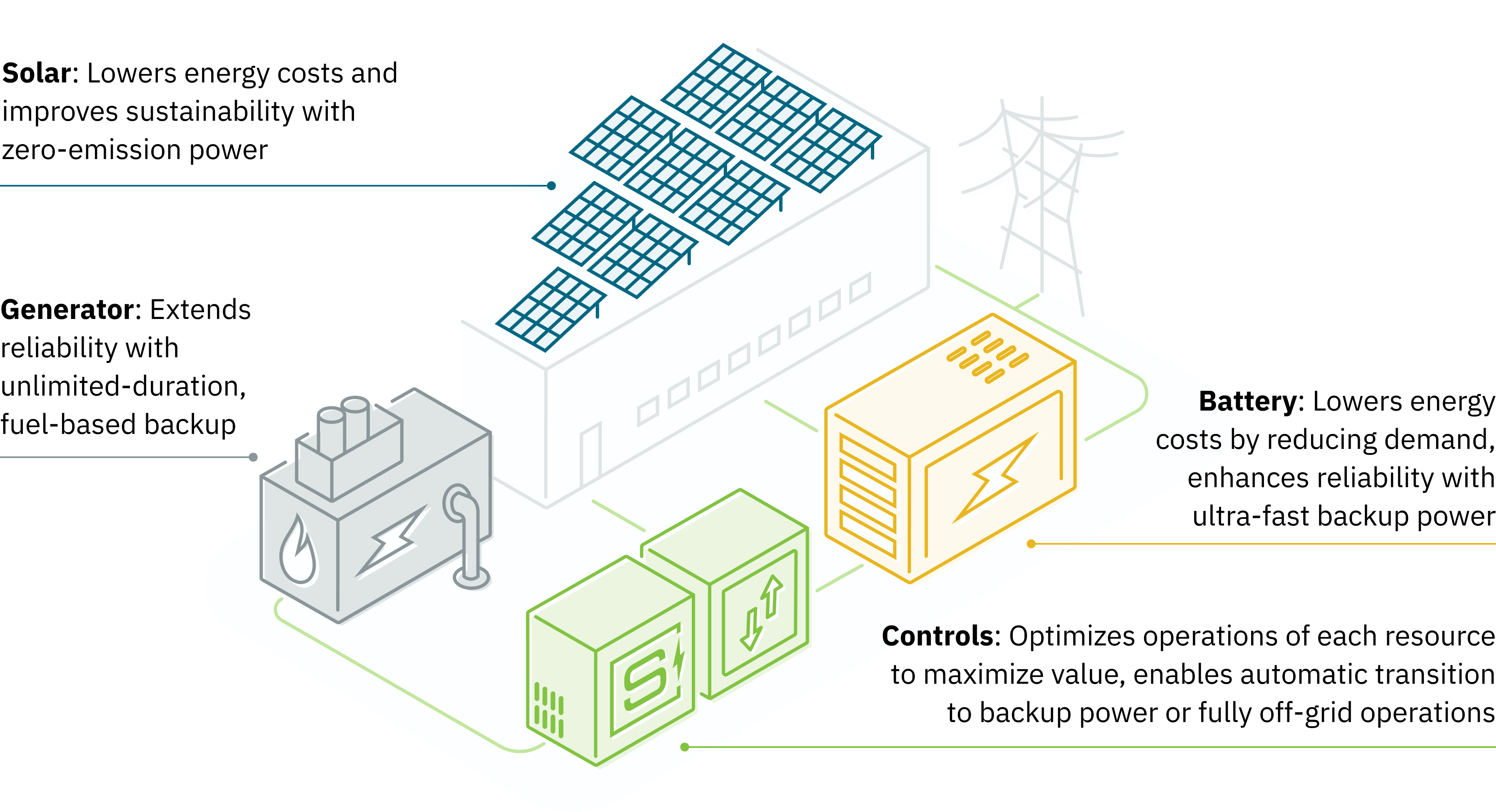
An advanced microgrid combines multiple on-site energy resources – typically solar, battery storage, and/or backup generators – that are orchestrated with intelligent controls. On normal days, these systems operate alongside the utility grid, with controls optimizing the use of energy from each distributed energy resource (DER) to minimize energy costs. In the event of a grid outage, these controls enable facilities to automatically isolate (or “island”) from the grid and rely on the microgrid to keep critical operations running.
Scale is the largest pure-play provider of advanced microgrid solutions in the U.S., and leverages expertly-designed controls, proprietary software, and the collective expertise of our team of industry veterans to deliver multiple benefits to our customers, including:
Optimized Cost Savings: For most of our advanced microgrids, cost savings start with on-site solar, which generates free electricity from the sun during the day – essentially, saving on the “energy” portion of your electricity bill. Battery storage, by contrast, enables businesses to save on the increasingly important “delivery” portion of the bill by drawing on stored energy to lower grid use during strategic hours of the day, month, and year. Scale continually updates battery dispatch strategies to ensure optimized cost savings based on evolving rate structures, utility programs, and market opportunities.
Enhanced Reliability: Unlike traditional generators that typically take 30 seconds or more to react to an outage and ramp up, Scale's advanced microgrids take advantage of the rapid-response capabilities of batteries to provide backup that activates in literally the blink of an eye. This can protect sensitive machinery from the costly “flickers” that are becoming more common on the regional grid, and we can even design systems that provide total ride-through protection for the most sensitive electronics. Many of our advanced microgrids also feature natural gas-fueled generators, which provide a source of unlimited duration, low-emission backup power in case of extended outages.
Speed-to-Power: As data centers increasingly consume all of the spare capacity on the regional grid, businesses looking to build new (or expand existing) commercial and industrial facilities risk facing multi-year delays to get the capacity they need. Advanced microgrids can typically be built within 2 years, and can be designed to enable rapid expansion over time – for instance, to add more solar capacity, or accommodate new loads like EV charging.
What Illinois incentives are available for solar and battery storage?
Illinois offers two main incentives for commercial solar and battery storage: the Distributed Generation (DG) rebate, worth $250 per kilowatt of solar capacity and $250 per kilowatt-hour of battery capacity, and Illinois Shines, which pays solar projects for the Renewable Energy Credits (RECs) they produce. Both were created by the landmark Future Energy Jobs Act of 2016 and expanded by the Climate and Equitable Jobs Act of 2021, and together they offer a one-two punch of support:
The Distributed Generation (DG) rebate: Administered through utilities in the state including ComEd, the DG rebate is an upfront, one-time payment of $250 per kilowatt for solar installations up to 5 MW in size and $250 per kilowatt-hour of capacity for batteries (with no maximum size) – enough to significantly reduce the costs of these key advanced microgrid components. Eligibility for the program requires a smart inverter configured to help support the ComEd grid when needed.
Illinois Shines: Initially known as the Adjustable Block Program, the (more evocatively named) Illinois Shines program provides payments to developers of customer-sited solar based on the value of the RECs a project is expected to produce. Projects are eligible to receive 15% of their expected lifetime REC value up front and the remaining value over the first six years of operations. Eligibility for this incentive requires the payment of an application fee as well as posting of collateral based on the lifetime value of the RECs.
Under Scale's partnership model, Scale manages applications and administration of these incentives, pays required fees, receives the funds, and uses them to proportionately lower the monthly fees charged by Scale's Microgrid Service Agreement (MSA). To date, we've secured nearly $50 million in state-level incentives to build projects for customers in New York, Connecticut, and California, all of which has flowed through to amplify their bottom-line economic benefits while eliminating the costs and complications associated with these programs.
Scale similarly manages the increasing complexity surrounding the federal Investment Tax Credit, which is still available for battery projects albeit with new sourcing restrictions. If this tax credit can be secured, its value will also be applied to reduce the monthly MSA price and further increase bottom-line savings generated by the project.
Why work with Scale?
Advanced microgrids are powerful platforms for energy resilience, enabling companies to navigate the grid challenges of today as well as the emerging risks of tomorrow. However, as you might guess from reading all of the above, the optimal design, operation, and financing of these systems requires a high level of expertise and experience.
Working with Scale means working with a leader in advanced microgrids, with a decade-long track record of working with these technologies and delivering results for customers ranging from steel manufacturing facilities to grocery stores to universities and more. And, thanks to the institutional capital backing of our equity partner EQT Group, along with over $1 billion in project financing to date, we can offer long-term value and financing certainty that's unmatched in the industry.
So, take a look at your ComEd bills over the past year or two, consider the costs of the reliability risks you face, and ask yourself what's coming next. If you want to lock in a more resilient energy future, reach out to our team today to start a conversation about what an advanced microgrid – and these lucrative Illinois incentives – could mean for your business.
Frequently Asked Questions
How much have ComEd commercial electricity rates increased?
ComEd commercial rates rose about 20% from 2024 to 2025 and have increased an average of 8% per year since 2020, compared with under 2% per year from 2005 to 2020. They aren’t coming down anytime soon, either; regional PJM capacity prices have cleared at their price cap for three consecutive annual auctions, locking in elevated costs through at least May 2029.
What is the Illinois Distributed Generation (DG) rebate worth?
The DG rebate pays $250 per kilowatt of nameplate solar capacity (for installations up to 5 megawatts) and $250 per kilowatt-hour of battery capacity as an upfront, one-time payment. Eligibility requires a smart inverter configured to support the ComEd grid when needed.
What is the up-front cost of a typical Scale advanced microgrid?
Nothing – Scale designs, builds, owns, and operates advanced microgrids under a Microgrid Service Agreement (MSA) with $0 down and a fixed monthly fee. Scale manages the incentive applications, pays the required fees, and applies the proceeds (including any federal Investment Tax Credit value) to lower the monthly price.