Resilient Supply Chains Need Resilient Power: How Advanced Microgrids De-Risk Logistics Facilities
September 4, 2026
|
John Atkinson
Summary
Ensuring supply chain resilience has become a major, board-level priority for large companies in recent years, and for logistics and distribution companies, electricity has become a growing source of risks: more frequent power outages that halt operations, grid constraints that delay new or expanded facilities, escalating electricity costs that erode margins, persistent customer demands for increased sustainability, and more. To combat these multiplying risks, logistics providers are turning to advanced microgrids that combine multiple on-site energy resources – for example, rooftop solar, battery storage, and dispatchable generation – with precise controls that optimize their operations to adapt to changing conditions on the grid.
Quality Custom Distribution (QCD), a national food service logistics provider, is showcasing how these cutting-edge solutions are delivering (pun intended) major results: the advanced microgrid Scale built at its refrigerated distribution warehouse in Southern California keeps its 24/7 operations online through any grid disruption, cuts its monthly peak demand charges by 45%, and enabled the company to electrify its fleet faster and more cheaply than if it had waited for a utility grid upgrade.
In June, we joined QCD, Volvo Trucks, and InCharge Energy for a Trellis webinar where we reviewed the first year of performance data from QCD's system and discussed lessons for supply chain resilience more broadly.
Why is energy a supply chain risk?
Energy is a supply chain risk because the reliability, cost, availability, and sustainability of power supplies can all disrupt the flow of goods or otherwise hurt the business of logistics providers. Four distinct risks are converging:
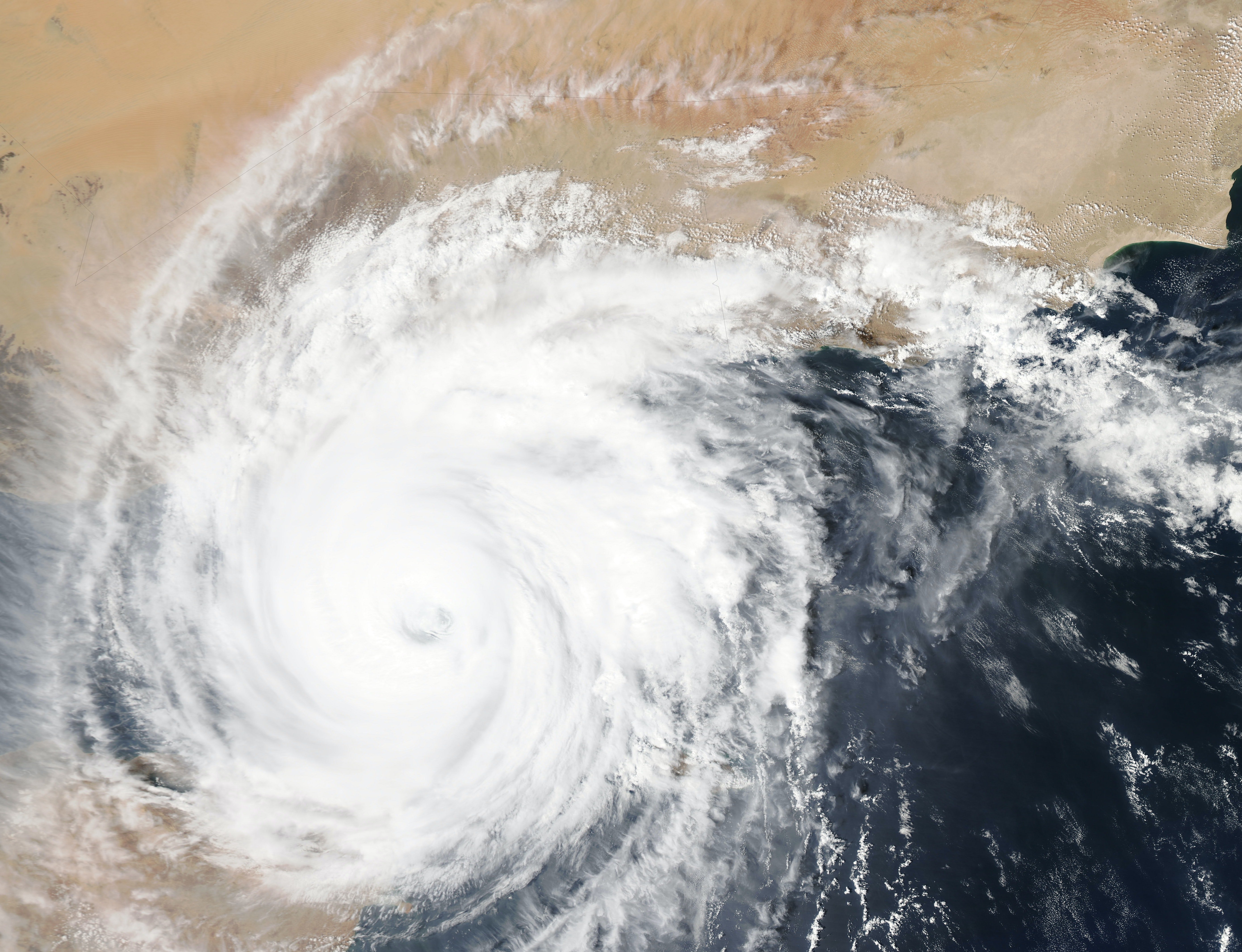
Outage risk. The annual duration of power outages experienced by the average U.S. customer recently hit the highest level in over a decade, driven by the combination of increasingly-frequent extreme weather events and a steadily-aging grid. For logistics and distribution facilities, even a brief outage can cascade into missed delivery windows, spoiled cold-chain inventory, service-level penalties, and angry customers.
Cost risk. On average, utility rates for commercial and industrial (C&I) customers have climbed over 25% since 2020, and rate hikes have been even more dramatic in some areas; in the mid-Atlantic region (including New York, New Jersey, and Pennsylvania), average C&I rates are up well over 40%, and in California average C&I rates have increased by 50%. Distribution is a thin-margin business, and unhedged energy costs are a direct threat to profitability.
Speed-to-power risk. When it comes to utility capacity delays, data centers may dominate the headlines, but logistics facilities sit in the same interconnection queues. Upgrades that once took two years are now quoted at four years or more in many regions of the country, including much of California, whether the new load comes from facility expansion, automation, or (as in QCD’s case) fleet electrification.
Sustainability risk. Political climates shift, but large corporate customers have kept pushing their logistics providers to decarbonize, driven by their own Scope 3 emissions commitments and disclosure obligations. For a supply chain company serving these types of sophisticated, Fortune 500-type companies, falling behind on sustainability can become a contract-renewal issue.
Supply chain companies have typically dealt with these issues in isolation, with solutions that are becoming less effective in many cases. For example, outage risks have traditionally been addressed with a diesel backup generator that sits idle 99% of the year, or addressing cost increases with third-party supply contracts that don’t do anything about the demand and coincident peak charges that make up a growing portion of their bills.
What is an advanced microgrid?
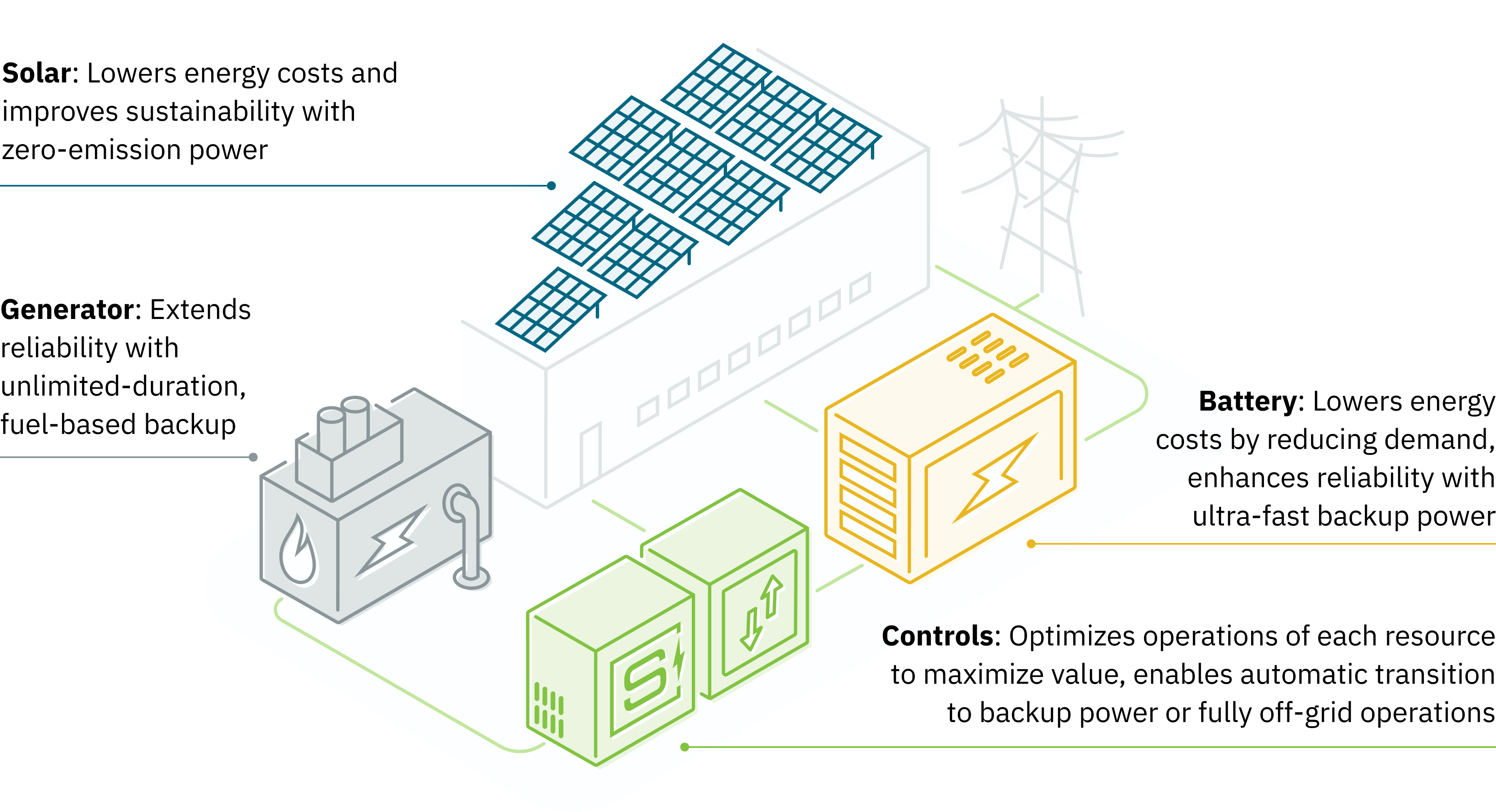
An advanced microgrid is a system of on-site energy resources, typically solar and battery storage along with backup generators, integrated with intelligent controls that optimize how each resource works alongside the utility grid. On a normal day, the controls dispatch the cheapest and cleanest power available; during a grid disturbance, the system islands from the grid and keeps operations running without interruption.
This is what we mean when we say that Scale's advanced microgrids redefine resilience. Whereas a backup generator answers a single question (what happens when the grid goes down?), advanced microgrids can answer all four: it delivers enhanced reliability, faster speed-to-power, optimized cost savings, and a sustainability platform, all from on-site assets. At Scale, we design, build, own, and operate these systems under a long-term microgrid services agreement (MSA), so facilities get all of these benefits with no upfront capital or operational complexities.
How QCD put an advanced microgrid to work
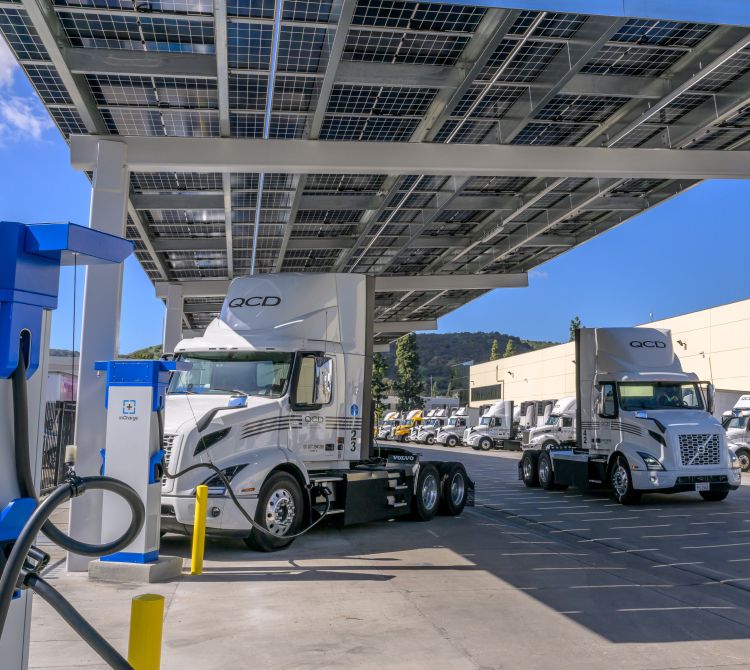
QCD is a nationwide, full-line food logistics provider making over 37,000 deliveries per week to more than 8,000 restaurant locations. Its La Puente, California refrigerated warehouse runs around the clock, with 45 routes dispatching nightly, and already had a significant load from cold storage equipment that was going to be doubled by the addition of electric vehicle (EV) chargers.
The company faced every one of the risks covered above: a Southern California grid prone to wildfire-driven disruptions, an electrification project that would have required a multi-year utility service upgrade, some of the fastest-rising electricity rates in the country, and growing sustainability expectations from one of its largest national customers, which is working to reduce Scope 3 emissions across its supply chain.
To address all of these risks, we built QCD an advanced microgrid that combines 1.26 MW of solar PV across the facility rooftop and carports, a 3 MWh battery energy storage system, and a 1.5 MW natural gas generator, all financed as a service over a 20-year term. The system powers the entire facility, from the refrigerated warehouse to the fast chargers serving QCD's fleet of 30 electric Volvo trucks. Here's how it has performed against each risk.
How does the microgrid protect QCD's operations from outages?
The microgrid islands from the grid automatically, transitioning the full facility to on-site power faster than a backup generator ever could. That matters for a site where the product is perishable and the delivery schedule has no slack. "If the power goes out, this microgrid clicks on within a couple of seconds and it's almost like nothing ever happened," said Larkin Williams, the Senior Director of Operations for QCD's West Region, on the webinar. "The lights stay on for QCD no matter what the weather may bring."
Unlike a standby generator, the resilience has layers of redundancy: solar, battery, and generator can each carry load, so no single failure takes the facility down, and extended outages can be met with low emissions and fuel costs due to the ability to draw on free “fuel” from the sun to meet power needs. Williams noted that energy reliability began as a side benefit of the project and quickly became central to how QCD thinks about it, given how "questionable" the Southern California grid can be during fire and heat seasons.
How did the microgrid solve QCD's speed-to-power problem?
The microgrid enabled QCD to add megawatts of new load for its electric vehicle (EV) chargers on its own timeline instead of the utility's interconnection timeline. QCD's existing service was near its limit, and the initial quote for an upgrade was at least two years – or very likely longer, considering that timelines for similar upgrades are now stretching to four or more. By generating and managing power on site, QCD avoided the need for an upgrade entirely and energized its expansion much sooner.
That's a lesson for large-load facilities across a wide range of industries. Whether the new load is automation, an expansion of cold storage capacity, or the addition of vehicle charging, on-site generation makes time-to-power a schedule variable that the business controls – not the utility. The webinar panel's unanimous advice: start the energy conversation as early in the site planning process as possible, because companies that take timely grid access for granted are the ones that get stuck waiting in the queue.
How is the microgrid reducing QCD's energy costs?
Over the first half of 2026, the microgrid avoided 30% of the facility's grid electricity use and cut monthly peak demand charges by 45% on average. The mechanics are (relatively) straightforward, if not exactly simple: solar serves the site and charges the battery through the day, and the battery discharges during Southern California Edison's 4 to 9 PM peak window, when rates are highest.
"These batteries turn on right around 4 PM, and we're running our operation off of them," Williams said. "This is probably the one piece that is saving us the most money – making sure we're off the grid as much as we can possibly be during those peak times."
The structural benefit to QCD’s balance sheet goes far beyond any single month's bill. The 20-year MSA with Scale locks in a substantial share of the facility's energy costs at predictable rates, insulating margins from utility rate escalation for the long term.
How does the microgrid serve as a sustainability platform?
The microgrid gives QCD a durable foundation for meeting its own sustainability goals and enabling it to adopt EV trucks to satisfy its customers' Scope 3 requirements. On-site solar now meets roughly 25 to 30% of the facility's energy use depending on season, and since coming online in 2025 the project has helped avoid 4.6 million pounds of CO2e emissions between the microgrid and the electrified fleet it powers.
That EV fleet will displace an estimated 145,000 gallons of diesel. For QCD's customers, who are scrutinizing the emissions of every link in their supply chains, that translates into measurable supply chain decarbonization they can report. "When you're able to tell your customer that I'm not going to need to use any diesel fuel to make your deliveries, that certainly perks them up," Williams said.
What should supply chain leaders take from this?
Confronted with these risk vectors, distribution and logistics companies should treat energy the way they treat other critical inputs: identify the points of failure and build redundancy against them.
QCD's results show that an advanced microgrid is the energy equivalent of dual-sourcing a critical input – one investment that hedges electricity outage risk, timeline risk, cost risk, and customer sustainability risk simultaneously.
The supply chains that navigated the disruptions of the last five years most successfully were the ones that built optionality before they needed it. Electricity supply deserves the same foresight.
How long does it take to deploy a microgrid at a distribution facility?
Advanced microgrids can typically be designed, built, and energized in 18-24 months, compared to utility capacity upgrades now quoted four years or more in constrained regions. Timelines do vary with permitting and equipment scope, however, which is why early engagement matters.
Does a microgrid make sense without fleet electrification?
Yes. Fleet charging was one driver for QCD, but the facility itself captures the reliability, cost, and sustainability benefits. Any 24/7 operation with high outage costs and meaningful energy spend is a candidate on those grounds alone.
Does a microgrid replace utility service?
Not necessarily. QCD's system is grid-tied: it works alongside utility service, using on-site resources to reduce grid demand and to island during outages. For sites where a grid connection is unavailable or years away, Scale also builds fully off-grid systems.
What does a microgrid cost upfront?
Under a microgrid services agreement, nothing. Scale finances, builds, owns, and operates the system, and the customer pays a service fee over a long-term contract, converting a capital project into a predictable operating expense.