Wildfires, Rate Hikes, and the Future of Electricity in California
March 25, 2025
|
John Atkinson
Summary
Wildfires drive statewide rate hikes: Utility spending on wildfire prevention is a primary driver of California commercial electricity rates rising more than 50% since 2020, with the CPUC authorizing $27 billion in wildfire-related costs from 2019 to 2024.
More frequent service disruptions: To prevent wildfires, utilities are using Public Safety Power Shutoffs, which hit a record 34 events statewide in 2024 and lasted days in some areas, alongside automatic equipment shutdowns that cause more frequent, less predictable outages.
Secure, affordable energy: Microgrids lock in lower costs and keep operations running through shutoffs – and Scale's $0-down Microgrid Service Agreement delivers them turnkey, from design through decades of operations.
The January 2025 Eaton and Palisades Fires in Los Angeles were unprecedented in the scale and speed of their destruction, a worrisome sign of the emerging risks we face in a warming world. More than a year later, their repercussions are still rippling through utility bills and grid operations across California – even for electricity users far outside the growing areas of the state designated as “High Fire Threat Districts.”
The good news is that, despite what the devastation in Los Angeles might suggest, utilities have made real progress in reducing the risks of catastrophic fires in the state. The bad news is, these efforts are adding significant costs to our electricity bills, and some preventive actions such as planned Public Safety Power Shutoffs (PSPS) events and increased sensitivity of protective equipment can lead to disruptions to electric service for hours or even days on end.
Read on to learn more about the link between wildfires, rising utility rates, and new reliability challenges – and discover how microgrids can help make your organization resilient against both price and outage risks by providing low-cost, on-site energy resources capable of operating independently from the grid.
Why have California electricity rates risen?
California commercial and industrial electricity rates have risen more than 50% on average since 2020, and utility spending on wildfire prevention is one of the primary drivers. The California Public Utilities Commission (CPUC) authorized the state's three largest utilities to collect $27 billion in wildfire-related costs from 2019 to 2024, and those costs now account for 15-25% of electric bills for their customers.
The spending, which includes prevention costs like the undergrounding of power lines as well as insurance, is happening for valid reasons. In 2007, SDG&E's equipment sparked three major wildfires, and in 2017 and 2018, following years of drought, SCE and PG&E saw their systems spark a series of catastrophic blazes – including the Camp Fire of 2018, which was accompanied by liabilities that drove PG&E into bankruptcy. According to the CPUC, the regulator responsible for approving utility investment plans, wildfires are “the single most significant risk” for these large utilities.
Utilities are working to mitigate this risk in a wide variety of ways, including the undergrounding and insulation of power lines, the installation of cameras and weather stations, the use of sensors to detect equipment disturbances, vegetation management (i.e. trimming trees near power lines), and, increasingly, the use of drones and AI to better inform vegetation management and equipment maintenance needs. With climate change extending California’s wildfire season across virtually the entire year – after all, the Eaton and Palisades fires happened in January – these investments are only becoming more important.
According to the utilities, these investments are proving effective at reducing wildfire risks, but they are also costly – especially in the case of undergrounding, which can cost from $2 million to $6 million per mile. And unfortunately, these important-but-expensive investments are ultimately paid for through utility rates.
The most recent figures are highest in PG&E territory, where wildfire prevention costs surpassed $5 billion, or over 25% of total costs billed to customers, in 2024, up from less than $100 million or 1% as recently as 2019. SCE and SDG&E (the smallest of the three utilities geographically) clocked wildfire-related spending that “only” accounted for over 15% of aggregate customer billing, at $3 billion and nearly $700 million, respectively.
In the aftermath of the Eaton and Palisades fires, utilities have been looking to increase these investments further, and the CPUC has shown it will authorize them – and even fast-track them. The CPUC has approved a program, authorized by the state legislature, that will expedite approvals for undergrounding utility infrastructure, perhaps the most effective but also the most expensive solution.
While the wildfire safety benefits of these investments are generally recognized by utilities, regulators, and the legislature, and while there are processes in place to control costs and seek sources of outside funding where available, the unfortunate fact is that the burden of financing this critical wildfire prevention work will fall heavily on Californians' utility bills.
Why are Public Safety Power Shutoffs and related outages becoming more common?
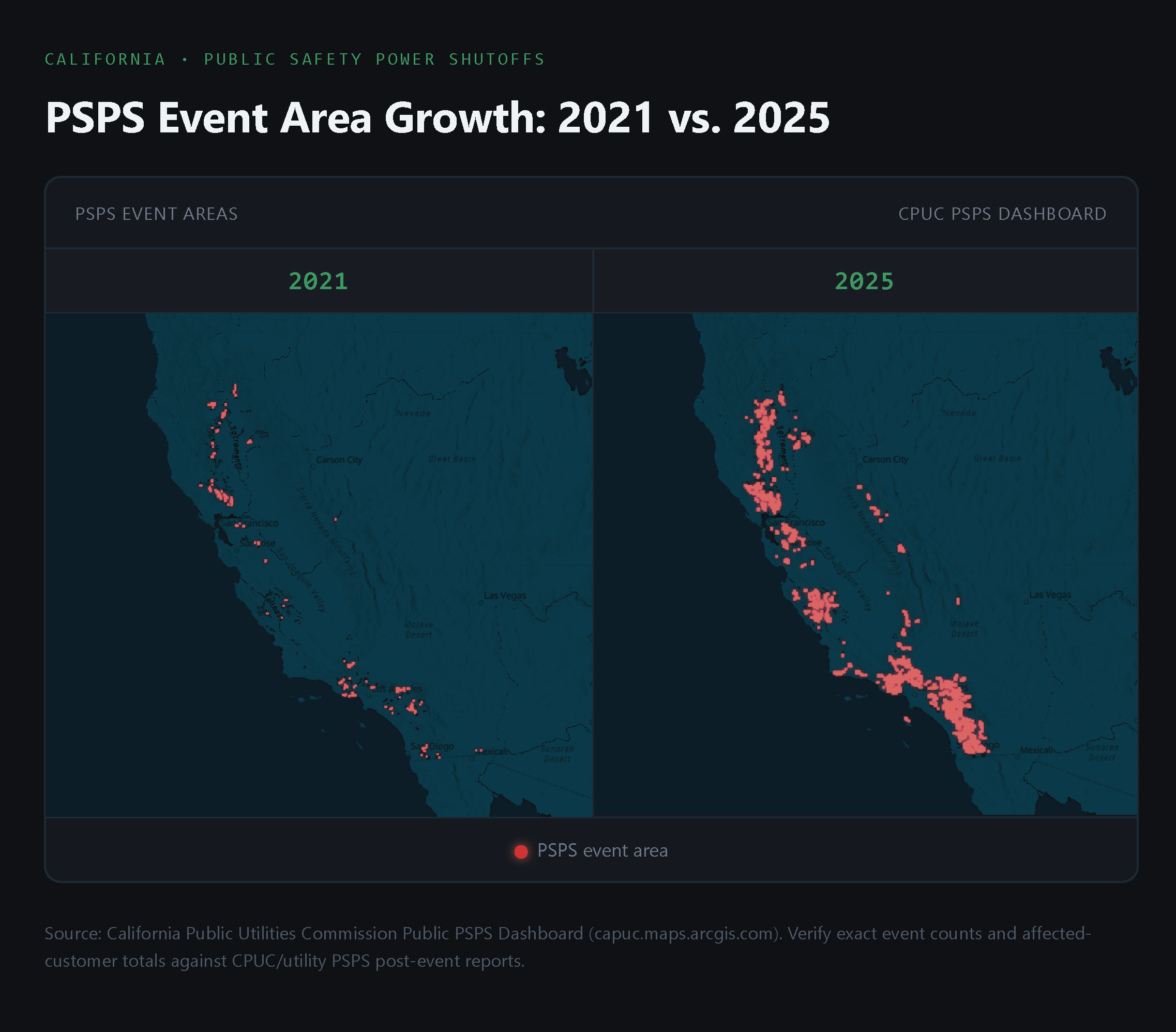
Public Safety Power Shutoffs (PSPS) are planned outages that California utilities call during high wildfire risk conditions – strong winds, high temperatures, dry vegetation – to prevent their equipment from sparking fires. Their use hit an all-time high of 34 events statewide in 2024, including 20 in SCE territory alone, with events lasting about 1-2 days on average.
Shutoffs exist because eliminating ignition risk entirely is impossible, no matter how much utilities invest. Even today, CPUC data on fire ignitions provides a sobering illustration: in 2025, SCE was linked to over 100 fires, and PG&E equipment reported over 400 fire incidents. To mitigate these unavoidable risks and, ideally, prevent “fire incidents” from igniting large-scale wildfires, the CPUC ruled in 2012 that utilities have the authority to shut down the grid entirely – a “PSPS event” – in a threatened area to protect the public.
At first, these PSPS events were primarily, and rarely, called in rural areas, but ever since the Camp Fire they have been used more often and across wider swathes of the state. In response to the Los Angeles wildfires, SCE called the largest PSPS event in its history, resulting in over 360,000 customers across eight counties losing power for as long as 15 days.
Beyond these multi-day PSPS outages, which typically are accompanied by an advance warning to provide time to prepare, businesses also face risks of shorter, more sudden outages from localized shutoffs of utility equipment. Protective equipment like circuit breakers can turn off automatically if disturbances are detected – for instance, if an animal or a tree branch makes contact with an energized power line.
In response to the fires, utilities have moved to boost the sensitivity of these protective settings, increasing the likelihood and frequency of these short, sudden outages. That can add up to significant costs for businesses in sectors like manufacturing, food processing, and biotechnology, where even losing power for a few seconds can cause disruptions in automated production lines or other sensitive processes that can take hours to recover from and cost tens of thousands of dollars.
How do microgrids protect against rate hikes and shutoffs?
Advanced microgrids are integrated systems of on-site energy infrastructure that use intelligent controls to orchestrate multiple resources such as solar arrays, battery storage, and/or dispatchable fuel-based generators. Microgrids can operate alongside the utility grid and optimize the use of energy from each resource to minimize overall costs, but if the utility grid goes down, microgrids have the ability to operate independently (or “island”) from the grid and use on-site resources to keep critical operations running.
Given the likelihood that utility prices will continue trending up over the long term, and that service interruptions will become more frequent, California businesses, educational institutions, and other organizations are seeking resilience against these rising electricity risks. Familiar solar installations can provide some insulation from rate hikes, but companies looking for a more robust and resilient solution are turning to advanced microgrids, which directly address both risks:
Optimized Cost Savings: Like solar-only installations, microgrids deliver everyday cost savings and provide a hedge against future rate hikes. However, advanced controls enable microgrids to deliver greater value by optimizing the use of battery storage to avoid using the grid when prices are high – for instance, during peak time-of-use (TOU) rate hours, or when demand charge penalties could be incurred.
If and when California utilities change their rate structures, as they have in recent years to disincentivize solar-only installations, these advanced controls can continually optimize and re-optimize microgrid operations to ensure maximum cost savings over the long term. Microgrids can also take advantage of new opportunities to secure additional revenues from demand response and virtual power plant (VPP) programs – all while ensuring that core operations are not impacted.
Enhanced Reliability: The ability to provide backup power during an outage defines microgrids, as most solar installations and even some solar-plus-storage systems don't have the ability to island from the grid. Microgrids, by contrast, can optimize the use of solar, batteries, and low-emission natural gas generators to provide ultra-reliable, unlimited-duration backup power – a more reliable, efficient, and low-emission solution than diesel backup generators.
Against the backdrop of increasingly-frequent and sudden automatic power shutoffs in California, the ability of microgrids to provide fast, “closed” transitions to backup power is also becoming more valuable. Unlike traditional generators that typically take 30 seconds or more to react to an outage and ramp up, Scale's advanced microgrids take advantage of the rapid-response capabilities of batteries to provide enhanced reliability performance, with backup that activates in literally the blink of an eye. This can protect sensitive machinery from tripping offline during sudden short outages, and we can even design systems that provide total ride-through protection for the most sensitive electronics.
Why work with Scale?
With their ability to mitigate price as well as reliability risks, microgrids offer a powerful solution for California organizations looking to lock in lower energy costs before wildfire-driven rate increases spiral further – or before an extended PSPS event (or lots of little power disruptions) takes a major chunk out of their budget. That's why the U.S. microgrid market has been growing at an annual rate of 32% according to Wood Mackenzie, and it's why California has more microgrid installations than any other state.
And, while microgrids are inherently complex, Scale has helped to pioneer a microgrid-as-a-service financial model that radically simplifies the process of securing the diverse benefits of this technology. Scale's Microgrid Service Agreement (MSA) contracts provide customers with a turnkey microgrid optimized to their site's specific energy needs for $0 down, with Scale providing end-to-end design, construction, and operations and maintenance services throughout the project's lifespan.
With Scale as a long-term energy partner, it's never been easier to adopt this technology – and in California, the energy security and affordability advantages of a microgrid have never been more urgently needed. If you're wondering what a microgrid could mean for your organization, we can provide rapid, accurate estimates of the potential benefits for your facility – reach out today to get started.
Frequently Asked Questions
What is a Public Safety Power Shutoff (PSPS)?
A Public Safety Power Shutoff is a planned outage that a California utility calls during dangerous fire weather – typically strong winds combined with high temperatures and dry vegetation – to prevent its equipment from igniting a wildfire. PSPS events last 1-2 days on average, and are being used over a wider area. A record 34 events were called statewide in 2024.
How much have California electricity rates increased?
Commercial and industrial electricity rates in California have risen more than 50% on average since 2020. A primary driver is wildfire prevention spending: the CPUC authorized $27 billion in wildfire-related costs from 2019 to 2024, and in PG&E territory those costs grew from under $100 million (about 1% of customer bills) in 2019 to more than $5 billion (over 25%) in 2024. They also made up over 15% of the costs paid for by SCE and SDG&E customers in 2024.
Can a microgrid keep a facility running through a multi-day shutoff?
Yes – an advanced microgrid with solar, battery storage, and a backup generator can detect an outage, automatically island from the grid, and run a facility’s critical operations on a combination of on-site resources for as long as the shutoff lasts. Scale also specializes in the design of advanced microgrids with enhanced reliability performance, leveraging the fast-response capabilities of battery storage to provide a near-instantaneous, “closed” transition to backup power that avoids the 30-second wait common with backup generators and protects sensitive operations from losing power.