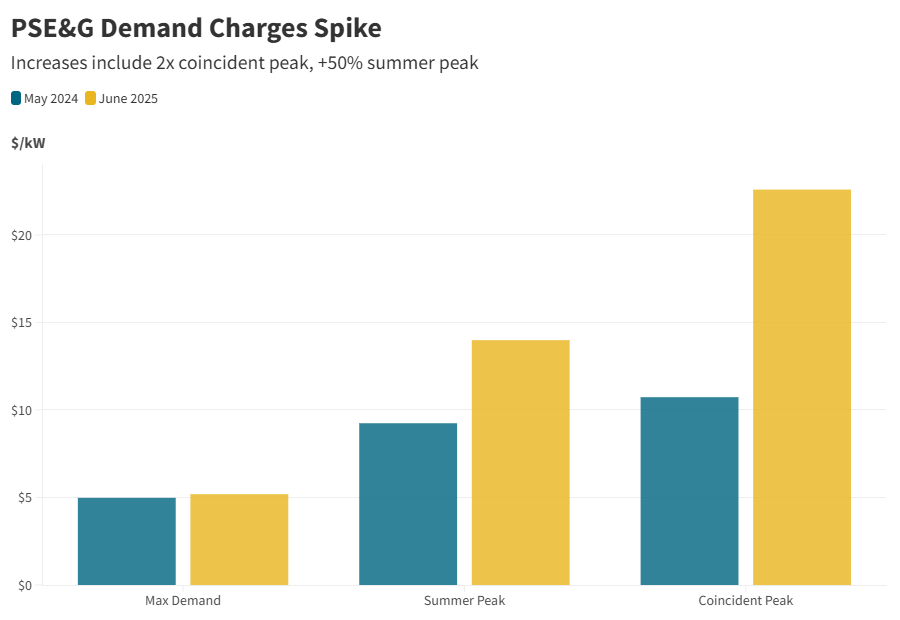
States across the U.S. are grappling with a soaring electricity prices – and a serious electricity supply crunch. Demand is rising for the first time in decades, pushed by data centers, electrification, and industrial growth, while new generation is stuck in interconnection queues measured in years. In response, grid operators, utilities, and policymakers are all increasingly turning to customer-sited battery storage as one of the few near-term solutions available to add needed grid flexibility while simultaneously addressing concerns over recent electricity rate hikes.
As part of this push, a growing list of states are now paying businesses directly to install and operate batteries to support the grid. For commercial and industrial (C&I) facilities, these programs stack on top of battery economics that are already favorable in states where fast-rising demand charges and coincident peak charges make up a large share of the bill. Batteries can also provide these businesses with enhanced reliability capabilities that are more valuable than ever, given the costs of even short disruptions to automated processes.
In Connecticut, Massachusetts, Illinois, and New Jersey, this combination of strong incentives and electricity rates that have been increasing 6-8% per year on average since 2020 are making customer-sited battery deployment especially appealing. And, as detailed below, Scale simplifies the process of taking advantage of these programs by taking care of all the varying administrative and operational requirements and passing on the savings as part of a lower, all-in monthly Microgrid Service Agreement (MSA) fee.
What battery incentives does Connecticut offer?
Connecticut's Energy Storage Solutions (ESS) program pays C&I customers performance-based incentives for making their batteries available during times of peak demand: $325/kW per year for small and medium-sized facilities (<500 kW peak demand) and $275/kW for larger facilities over the first 5 years, then $175/kW in years 6-10 for both categories. That adds up to hundreds of thousands of dollars a year in revenues for a typical large C&I-scale project.
ESS program payments are earned through "active dispatch" events called by the utilities when the grid is under stress – typically 30 to 60 events each summer, plus up to 10 winter events under the expanded winter season. The program was recently restructured to eliminate a previous up-front incentive and increase ongoing performance payments. In other words, it’s been refined to reward the batteries that actually show up when needed.
That's where operator experience matters. Incentives flow through certified Third-Party Operators (TPOs) like Scale, and we've served as TPO for projects accounting for over 60% of the program's C&I ESS funding to date. We design systems to meet program requirements, dispatch them during every event window (unless the customer opts out of a given event) and use the incentive to lower your monthly service fee.
What battery incentives does Massachusetts offer?
Massachusetts supports C&I batteries through the ConnectedSolutions and Clean Peak Energy Standard programs, plus a new rate structure that rewards peak reduction directly on the bill, adding up to a triple stack of potential value.
- ConnectedSolutions: Similar to Connecticut’s Energy Storage Solutions program, ConnectedSolutions pays batteries for supporting the grid during times of peak demand. From June through September, batteries must dispatch up to 60 times for up to 3 hours at a time, in exchange for an incentive of $200/kW of average summer performance – totaling tens or hundreds of thousands of dollars in annual value.
- Clean Peak Energy Standard: This Renewable Portfolio Standard (RPS)-style policy requires utilities to source a rising share of their peak energy supply from clean resources, reaching over 50% by 2050. Utilities buy Clean Peak Energy Certificates from qualifying resources, including batteries charged primarily by solar and demand response, both of which an advanced microgrid can provide. The alternative compliance payment that typically sets the market price rose to $65/MWh starting in 2026.
- Monthly coincident peak rates: C&I customers now have the opportunity to opt into a monthly coincident peak rate class that rewards reducing grid consumption twelve times a year, which we estimate can cut bills 10–15% for customers whose batteries reliably hit those windows.
This multi-layered value stack grows even higher if the battery is integrated with solar in an advanced microgrid configuration, with an opportunity to benefit from the SMART 3.0 incentive. Of course, each of these programs has its own enrollment windows, performance rules, and paperwork – all of which add up to a considerable “stack” of complexity that Scale manages for customers under the MSA model.
What battery incentives does Illinois offer?
Illinois offers a pair of incentives for behind-the-meter solar and storage, both created or expanded under the 2021 Climate & Equitable Jobs Act.
- Illinois DG Rebate: The DG rebate features up-front payments of $250/kWh for battery storage and $250/kW for distributed solar generation. That’s enough to reduce the cost of a commercial-scale battery by hundreds of thousands of dollars, and adding solar in an advanced microgrid creates an opportunity to stack additional incentive value. In 2028, the DG Rebate transitions to the VPP Tariff program, which will pair up-front payments with performance payments for system peak reduction similar to the Massachusetts and Connecticut programs.
- Illinois Shines: This state program managed by the Illinois Power Agency purchases Renewable Energy Credits from distributed solar in advance, with roughly 15% paid up front and the remainder over the first six years of operation. REC prices for larger commercial systems (2–5 MW) run $31–50/REC, and Illinois Shines value can stack with the DG Rebate.
Illinois Shines does require applicants to put skin in the game up front: a non-refundable application fee of up to $15,000 and 5% of contract value posted as collateral. For customers with a signed LOI, Scale pays the application fees and posts the collateral ourselves, so these requirements don’t impact your balance sheet.
What battery incentive does New Jersey offer?
New Jersey is aiming to follow this trend, with its own upcoming battery incentive program that promises relief for businesses facing major rate hikes. The state carries a mandated target of 2,000 MW of energy storage by 2030 under its Clean Energy Act, and the Board of Public Utilities is rolling out the Garden State Energy Storage Program (GSESP) in phases to get there. Phase 1, launched in June 2025, targeted at least 1,000 MW of transmission-scale storage. Phase 2 – the one that matters for businesses – covers distributed and behind-the-meter storage with a mix of fixed and performance-based incentives.
The BPU released its Phase 2, Block 1 straw proposal in August 2026, proposing annual performance payments for awarded capacity for 10 years, with the first block expected to open by mid-2027 and C&I-focused opportunities outlined as the framework expands. Program design details are still being finalized through the stakeholder process, but the direction is clear – and BPU proposals to date point toward incentives of similar value to the other programs discussed here, reaching tens or hundreds of thousands of dollars for C&I installations.
Funding will be limited and awarded competitively, which means the projects that win will be the ones with interconnection applications accepted, site control secured, and permitting plans in place before the window opens.
How does Scale help you capture these incentives?
Every incentive on this list comes with significant application, administration, and/or operational requirements: enrollment windows, dispatch obligations, collateral postings, equipment eligibility lists, performance factors, and more, which can vary widely from program to program. But under Scale’s Microgrid Service Agreement (MSA), we design, build, own, and operate the system with $0 down; we handle every application, filing, and performance requirement; and the stacked incentive value shows up for you as a lower monthly service fee, not a stack of paperwork and operational complexity.
Thanks to the appeal and effectiveness of this model, Scale has secured over $47 million in state-level battery incentives for our advanced microgrid customers across the country. If your facility sits in one of these four states – or one of the many others where demand and coincident peak charges already make batteries pencil – the time to start planning to take advantage of this strong incentive environment is now. Talk to our team about what your site qualifies for.