Electricity Rate Resilience: How Advanced Microgrids Reduce Energy Costs
November 17, 2026
|
John Atkinson
Summary
Managing today’s rate hikes: Electricity rates are up 25% nationally since 2020, and over 50% in some states – but advanced microgrids can cut these costs since a growing share of rate increases depend on when power is used, not how much.
Scale targets maximum value: Scale’s advanced microgrids use batteries to capture three types of value streams – energy savings, demand and/or coincident peak savings, and grid services revenues – without impacting your operations.
Save from day one: Our fully-financed, $0 down microgrid service agreements (MSA) enable businesses to replace a capex investment with day-one opex savings, while locking in stable long-term costs for a significant share of their energy needs.
When energy industry professionals hear the word “resilience” they typically think “power outages” and “backup generators.” But for most people, resilience means a lot more than that – it means the ability to stay strong and bounce back during challenging times. And, similarly, for businesses it means “dealing with adversity and shocks, and continuously adapting for growth,” according to McKinsey.
In recent years, one major source of “adversity and shocks” for businesses has been skyrocketing electricity bills. And their bills aren’t rising simply as a function of how many kilowatt-hours they use – they’re increasingly being penalized based on when they use those kilowatt-hours, which for most businesses is impossible to control without impacting their operations.
Scale’s advanced microgrids are integrated, intelligent on-site energy systems that give businesses resilience against both power outages and these rising electricity costs. By leveraging our expertise in solar, battery storage, and microgrid controls, Scale designs and operates these systems to deliver dynamically optimized cost savings that adapt alongside today’s changing utility rates.
And crucially, our systems can deliver these savings without impacting facility operating schedules.
Scale also offers the energy financing required to provide this resilience through a $0 down Microgrid Service Agreement (MSA) that eliminates up-front costs and replaces utility cost volatility with a predictable, locked-in monthly fee designed to provide savings from day one. Because for most companies, truly optimal savings don’t impact capital budgets.
Read on for a deep dive into why utility costs have become such a challenge – and how Scale’s advanced microgrid solutions provide resilience against these rate hikes in multiple ways.
Why ElectricityRates are Skyrocketing – and Evolving
Over 70% of businesses nationwide have seen prices increase faster than inflation from 2020-2025, with average utility rates for commercial and industrial (C&I) customers climbing over 25% since 2020. These rate hikes have been even more dramatic in some regions; in the mid-Atlantic region (including New York, New Jersey, and Pennsylvania), average C&I rates are up well over 40%, and in California average C&I rates have increased by an eye-watering 50%.
These rate hikes are raising eyebrows not only because of how much rates are going up, but why and how they’re going up.
While different regions have different drivers, an overarching national trend is that the cost of transporting electricity to customers across the utility grid – the “delivery” component of electricity bills – is growing more than the cost of generating electricity itself, or the “energy” portion. According to data from Lawrence Berkeley National Laboratory, while utility spending on generation has dropped nearly 10% compared to a decade ago, utility spending on distribution grids nationwide has grown by over 60%, alongside an increase in transmission spending of over 20%.
This increase in transmission and distribution (T&D) costs is being driven by a variety of factors including the replacement of aging grid infrastructure, the development of new power lines, and, in some regions, steps to protect the grid against extreme weather events. Most dramatically, in California, utilities are moving power lines underground to protect against wildfires at costs that can surpass millions of dollars per mile, and overall wildfire-related expenditures (including undergrounding, vegetation management, and insurance) now add up to 15-25% of the annual costs that get passed on to ratepayers.
Regionally specific energy market dynamics can also be a major driver of rate hikes. Within the PJM electricity market region, which includes most of the mid-Atlantic from Maryland to New Jerseyto Illinois, a combination of surging demand – driven largely by data center growth – and fossil fuel plant retirements has caused unprecedented increases for capacity during annual grid peaks, with the last three capacity auctions clearing at the market cap and locking in continued rate hikes for years to come.
Regardless of why rates are increasing in different regions, in many cases they’re hitting utility bills in a similar way: electricity costs increasingly depend not only on how much electricity your facility uses, but when it uses electricity. That hit can take several forms, including:
Time-Of-Use (TOU) or Peak Rates, which charge more for electricity during weekday hours of peak demand – typically in the middle of the day, although in California peak rates have shifted towards early evening in response to the “duck curve” caused by solar production.
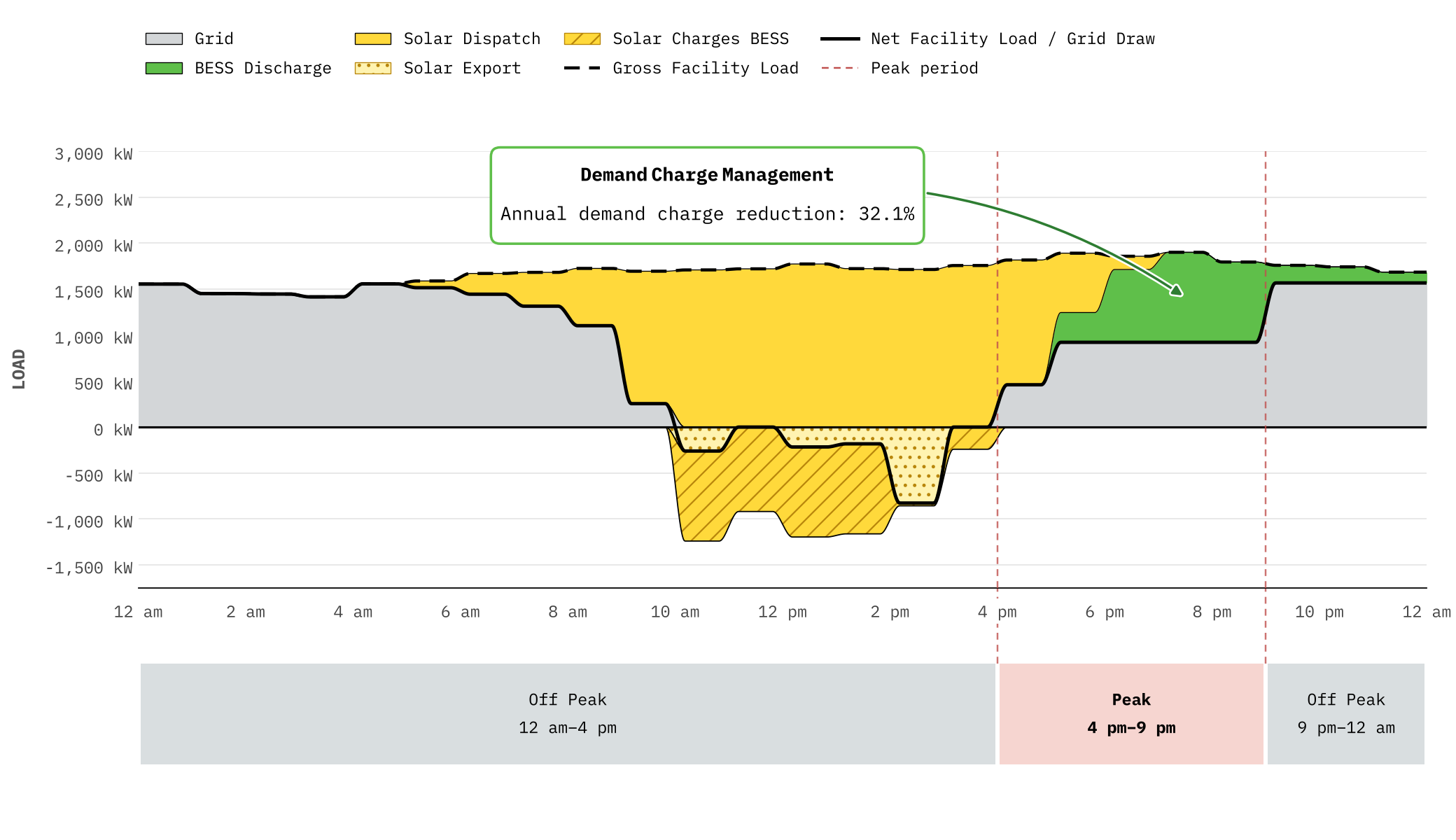
Demand Charges, which are billed each month according to a facility’s highest demand (in kW) registered during any single interval in the billing period (typically 15 or 30 minutes). According to Arcadia, demand charges make up more than 30% of the electricity bill for roughly a third of businesses nationwide, and can reach 70% for customers with especially “peaky” load profiles.
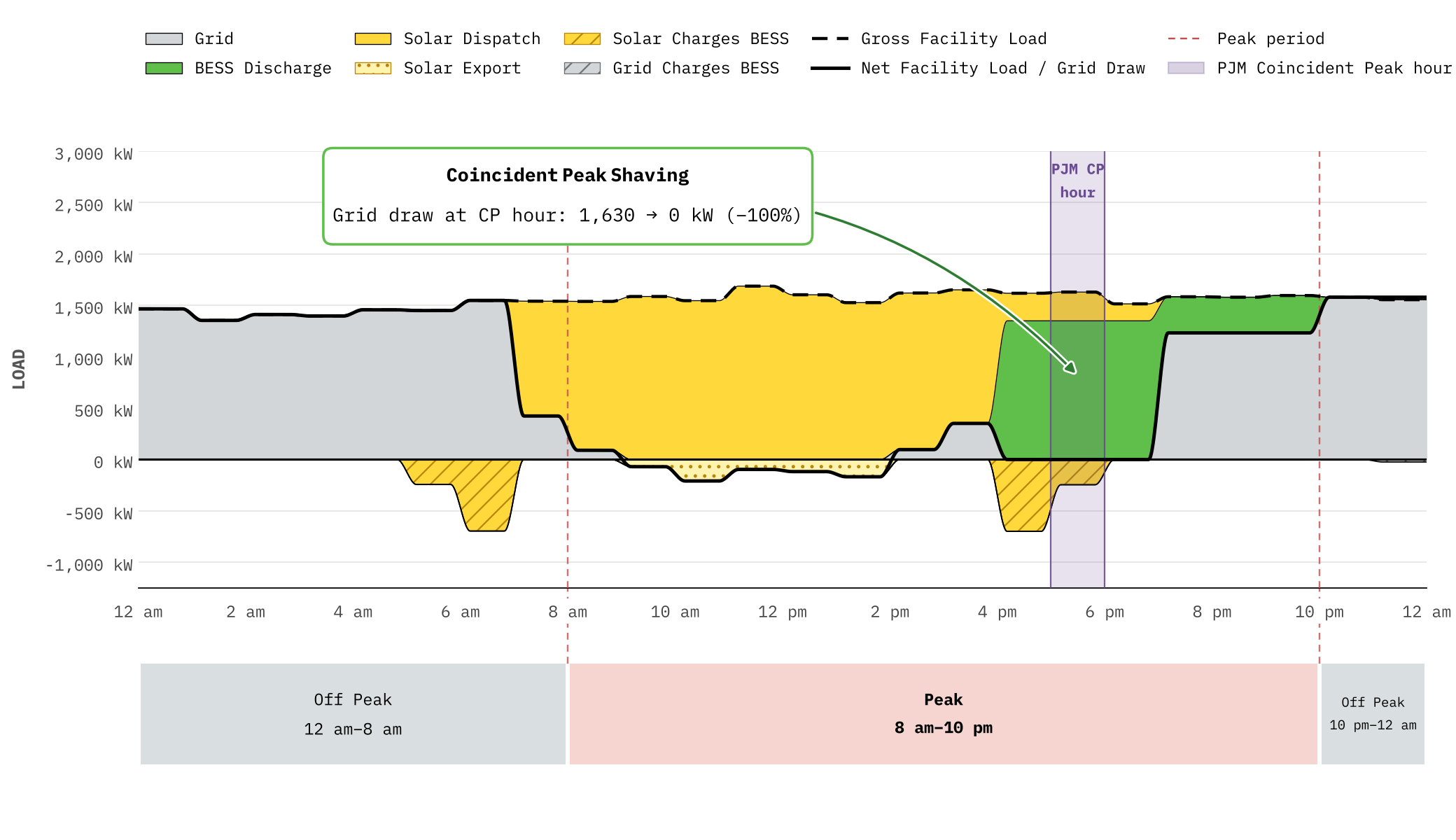
Coincident Peak Charges, including capacity charges as well as transmission charges, are based on a facility’s energy use during one or more hours of peak demand on the grid every year (e.g. a hot summer day) – in other words, their energy use that “coincides” with the grid’s peak. Customers in areas like the PJM region are seeing some of the biggest increases here, as new demand outpaces new generation amid coal plant retirements.
The bottom line: if your operations use too much energy at the wrong time, demand and/or coincident peak charges can have a much bigger impact on your budget than they did a few years ago. And, with utility capital spending at record highs and demand still climbing, there’s little relief in sight.
And, unlike rate increases driven purely by increased generation costs, these new cost increases aren’t always hedged by the third-party supply contracts that have been a mainstay of corporate energy strategies. Rooftop solar, another popular cost-saving tool, is similarly becoming less effective, as shifting TOU hours and changing net metering policies weaken the economics of solar-only installations.
How Advanced Microgrids Generate Value in Three Dimensions
For some of our customers, the ability to avoid regularly occurring operational disruptions with Scale’s enhanced reliability capabilities can save hundreds of thousands or even millions of dollars in lost revenues every year. But most of our customers are also motivated by a desire for everyday “blue sky” cost savings compared to relying on their utility – and Scale’s advanced microgrids deliver on this front, too.
Scale goes beyond the simple cost savings provided by traditional solar installations by combining multiple types of on-site assets to generate more types of value streams. We often use the metaphor of “one-dimensional” versus “three-dimensional” value when comparing the two: while solar solely provides value by replacing utility energy at the time of generation, the advanced microgrid can provide three distinct sources of economic value.
Energy Savings: As with solar-only installations, an advanced microgrid with on-site solar generation reduces the aggregate amount of electricity purchased from the grid. But advanced microgrids go further by using battery storage to shift everyday energy use to charge when the grid is cheap and discharge during hours when rates are high.
Demand and Coincident Peak Savings: Whether charged from solar or from the grid, batteries can shave demand charges by cutting grid use during a facility’s hours of maximum monthly demand; similarly, they can reduce their coincident peak charges, including both capacity and transmission charges, by targeting the highest annual hours of demand on the grid.
Grid Services: Advanced microgrids can also generate grid services revenues by using stored energy to participate in demand response programs, frequency regulation and capacity markets, virtual power plants (VPP), performance-based incentive programs, and other emerging opportunities.
Scale’s expertise and proprietary software allow us to model all of these potential sources of value, including battery exports for grid services – an increasingly important category of value that most modeling approaches miss. We then optimize system designs to maximize total economic returns across all three dimensions.
Once the system is up and running, our microgrid controls dispatch the battery during those hours of the day, month, and year when utility prices – or grid service revenue opportunities – are highest, enabling customers to adapt to changing grid conditions and rate structures without impacting their operations.
Specific battery dispatch strategies will vary according to different facility load profiles and utility rate structures in different parts of the country.
For example, California businesses facing high demand charges and TOU rates can dispatch batteries to minimize monthly demand peaks and shift grid use to cheaper hours of the day.
In PJM states like New Jersey and Illinois, batteries can create significant value by targeting the handful of hours of peak grid demand over the course of the year to avoid the coincident peak charges that are driving cost increases across the mid-Atlantic.
By dynamically optimizing dispatch based on all of these opportunities, Scale maximizes the overall value we create for our customers every hour of the day throughout the system’s life. That includes re-optimizing the system’s dispatch strategy to adapt to future changes in tariff structure (e.g. shifting TOU windows or demand charge levels) and to take advantage of emerging opportunities to create value – for example, participation in a new VPP program.
That’s because our partnerships are based on providing true long-term value for our customers. And, with our microgrid service agreement (MSA) contract structures, those savings start from day one.
A Partner From Day One
Scale isn’t just an industry leader because of our technical expertise. Our Capital Solutions team has extensive experience financing a wide range of on-site energy projects including advanced microgrids, and we pioneered the development of microgrid-as-a-service contracts for our customers.
Similar to a traditional energy-as-a-service (EaaS) contract, Scale’s MSA is a $0 down, turnkey agreement with a monthly service fee that includes the costs of designing, engineering, constructing, operating, and maintaining the system throughout the project life. This enables customers to convert an increasingly volatile operating expense into a predictable, lower-cost line item – a built-in hedge against future rate increases. It also lets them make decisions about their energy future based on their desire for long-term value and resilience without taking on up-front costs or operational complexity.
In light of today’s fast-evolving grid landscape and its expanding opportunities for grid services revenues, Scale has added another layer of innovation to our MSA: the Customer First Value Share (CFVS) contract structure. Under CFVS, Scale operates the microgrid to maximize total value, treating bill savings and grid revenue equally for the full project term. If a grid revenue opportunity in a given month is worth more than the bill savings it displaces, we have the flexibility to pursue it, because what matters is the combined number.
The allocation follows two simple principles.
Risk Reduction: You get paid first – all value generated, from either source, goes to the customer up to an agreed sharing threshold. This reduces your downside risk by enabling grid services revenues to fill the gap if bill savings ever underperform expectations.
Customer Alignment: Value above the sharing threshold is split between Scale and the customer at an agreed-upon rate, which keeps our incentives permanently aligned. When a lucrative new VPP program launches in your territory five years from now, Scale will re-optimize dispatch to participate – because we benefit when you do.
Our ability to wrap complex, multi-asset advanced microgrids – and their diverse value streams – in financing solutions designed to meet customer needs is emblematic of what makes Scale different: hard-won expertise and the strong partnerships that sit at the heart of our approach to resilience.
Because navigating today’s fast-changing energy landscape requires an experienced copilot, one ready to help you adapt and thrive amid every energy challenge and risk you face, including rising and rapidly evolving utility rates. And that’s what we give our customers, with a combination of advanced technology and embedded intelligence that generates optimized cost savings from day one and for decades to come.
Reach out to Scale today at info@scalemicrogrids.com to learn how a microgrid can turn energy challenges – rising utility rates included – into a competitive advantage.
Frequently Asked Questions
What is a demand charge?
A demand charge is a monthly fee based on your facility’s highest rate of electricity use (in kW) during any single interval, typically 15 or 30 minutes, in the billing period. For roughly a third of businesses nationwide, demand charges make up more than 30% of their electricity bill.
What is a coincident peak charge?
A coincident peak charge is the portion of an electricity bill based on a facility's energy use during one or more hours of highest overall grid demand, rather than the facility's own peak. Under Massachusetts' new optional rate class from National Grid and Eversource, this charge is set monthly instead of annually, so businesses that reduce grid use during each month's peak hour can reduce their electricity bill twelve times a year.
How does a microgrid reduce electricity costs?
An advanced microgrid combines solar, battery storage, and intelligent controls to shift when a facility draws power from the grid. That timing shift captures energy savings, demand and coincident peak savings, and grid services revenues at once, without changing how the facility operates.
What is a Microgrid Service Agreement (MSA)?
An MSA is a $0 down, turnkey contract that covers designing, engineering, constructing, operating, and maintaining a microgrid for the life of the project. Customers pay a predictable service fee and start saving from day one, with no capital outlay.